

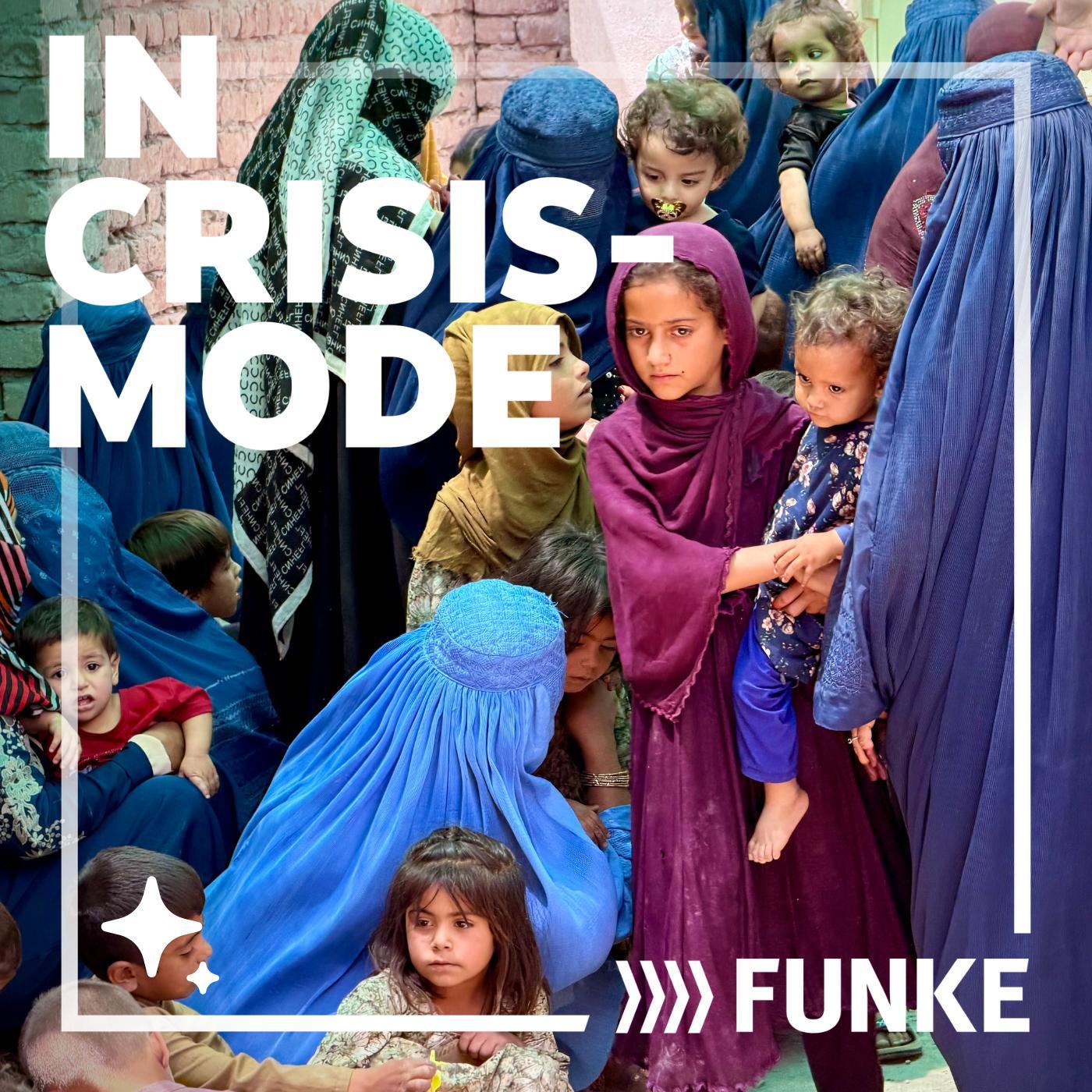
Im Krisenmodus· Folge 171
Afghanistan Five Years Under the Taliban: Safer, but Not Free
Samstag, 5. September 2026 · 25 min
Kapitelklicken springt direkt hin
Shownotes
This Episode is made with the help of AI
_____________________________________________
Five years after the Taliban seized power, Afghanistan has changed fundamentally. Major fighting has died down in many parts of the country, the security situation has improved, and construction is picking up again. At the same time, many people are living in poverty, unemployment remains high, and women and girls are excluded from secondary and higher education.
In this episode of Im Krisenmodus, FUNKE war and crisis reporter Jan Jessen (morgenpost.de/politik/article412853039/fuenf-j…) speaks to people experiencing this new reality in very different ways.
In Kabul, Jan meets teacher Rohina Popalzai. Rohina talks about women who have lost educational and professional opportunities – and about her cautious hope for change.
In Logar Province, Jan meets brickworks owner Abdul Rahman Bhatti. His business has grown over the past five years. He sees the improved security situation as one reason why people are returning, investing and building houses again.
How limited that security can be becomes clear to Jan in the border province of Paktia. There, doctor Fathullah stands amid the ruins of his home. His 14-year-old brother was killed in an airstrike, while Fathullah and his wife were seriously injured. Fathullah also describes a second attack on people who came to help the wounded.
What have five years of Taliban rule changed in Afghanistan? And who has the country actually become safer for?
In this episode
Jan Jessen – Head of Politics at NRZ and war and crisis reporter for FUNKE Media Group
Rohina Popalzai – Teacher and spokesperson for a state school in Kabul
Abdul Rahman Bhatti – Brickworks owner from Logar Province
Fathullah – Doctor from Paktia Province and survivor of an airstrike on his home
Chapters
01 | What has changed under the Taliban?
Five years after the Taliban seized power, Jan Jessen travels through Afghanistan. The country has become safer in many parts, while poverty, unemployment and severe restrictions on women continue to shape everyday life.
02 | Rohina Popalzai: Women Shut Out of Higher Education
The teacher from Kabul talks about girls’ education, the lack of educational and professional opportunities for women.
03 | Abdul Rahman Bhatti: Why Construction Is Picking Up Again
A brickworks owner in Logar talks about rising demand, Afghans returning home and the economic impact of the improved security situation.
04 | Fathullah: An Airstrike on His Family
The doctor from Paktia talks about the airstrike on his home, the death of his 14-year-old brother and a second attack on people who came to help the wounded.
05 | Who Is Afghanistan Safer For?
Three encounters reveal the contradictions of five years of Taliban rule: greater security and renewed construction on the one hand, fewer freedoms for women and continued violence in some parts of the country on the other.
Recommended Episodes
Earthquake in Afghanistan – Survivors Without Help (morgenpost.de/podcast/article409960456/erdbebe…)
Flood Disaster in Afghanistan: A Forgotten Tragedy (morgenpost.de/podcast/article406857258/flutkat…)
Afghan Children: Seeking Treatment in Germany (morgenpost.de/podcast/article407680358/afghani…)
Contact & Feedback
Questions, criticism or suggestions? Get in touch:
✉️ krisenmodus@funkemedien.de
Subscribe now
Im Krisenmodus – wherever you get your podcasts:
Spotify (open.spotify.com/show/0IQW1w25NYSrz60aAPzwvB?s…) | Apple Podcasts (podcasts.apple.com/de/podcast/im-krisenmodus/i…) | Deezer (deezer.com/de/show/3737197) | YouTube (youtube.com/@Krisenmodus-Podcast_FUNKE)
New episodes
Every two weeks, on Wednesdays.
In Crisis Mode is a podcast by FUNKE Media Group.
Transkriptvom Podcast bereitgestellt · Zeitmarken springen hin
Die Übersetzung von Jans Stimme vom Deutschen ins Englische wurde mit einer KI erstellt. Es ist jetzt fünf Jahre seit der Taliban zurückgezogen in Afghanistan. Seit dann, da gab es keine Krieg in der Lande. Für 40 Jahre, die Menschen in Afghanistan mussten eine Krieg haben. Die Krieg gegen die Soviets, die in 1979 invaded, dann die Afghan-Civil War, dann die Reise der Taliban für den ersten Mal, die 20-jährige occupation, die in 2001 begonnen hat.
Und in all diesen Jahren, the country was repeatedly shaken by conflict. Now there is a relatively stable peace. Reconstruction is underway and people are returning. But what does this new stability actually mean for the people living there? A teacher in Kabul says, We are not pessimistic, but optimistic. We hope that this situation will not continue and that their decisions and attitudes will change.
Perhaps there is a problem or a reason why you haven't started yet. You know this best. We hope that the education system will improve and that schools and universities will reopen for girls. Every Afghan family dreams of their daughter becoming a doctor or an engineer. What else can we do? We can only hope.
Hope in this conversation is not some grand political programme. It is more of what remains for Rohina, and not just for her, but for millions of other women in Afghanistan. In Crisis Mode, the podcast from Conflict Zones with Jan Jessen. Hello, I'm Jan Jessen, political editor-in-chief and war and crisis reporter for Funker Media Group.
Five years ago, the Taliban retook power in Afghanistan. At the time, on August 15th, 2021, I was there. It was an extremely chaotic, turbulent and of course deeply troubling time. There was panic. Ich habe gesehen, wie die Leute nach dem Flugzeug streamen, mit hunderte und tausend von ihnen, die sie desperately versuchen, einen Weg aus dem Land zu finden.
Für mich persönlich, muss ich sagen, es bleibt eine sehr schockende und traumatische Erfahrung heute. Ich habe nie so schlecht in meiner ganzen Karriere als Journalist als ich damals war, als ich nach dem Flugzeug gekommen bin, mit meinem deutschen Passport. Und die Leute fiel mich an, sagen, Sir, Sir, please help me, help me, help me.
Und natürlich, da war nichts ich konnte, ich einfach durch mit meinem Passport. Die Amerikaner Marines haben ihren Weg durchgegangen, um uns zu entfernen. Und dann haben wir uns auf die Pläne gemacht. Das war ein sehr bitter Moment, ich muss sagen. Heute, die große Krieg hat in vielen Teilen des Landes.
Und das ist eigentlich eine der Dinge die meisten Leute sagen, wenn man sie mit ihnen spricht. Ordinary Leute, die von den Provinzen kommen, zum Beispiel zu Kabul, sagen sie, dass für die erste Zeit in 40 Jahre, They can essentially travel safely and freely, from even the most remote parts of the country to the capital.
They no longer have to constantly fear falling into the hands of one warlord or another. They no longer have to worry about bombs going off somewhere or roadside explosives detonating, many of which were planted by the Taliban at the time. So the major war, those four decades of war, is over. The security situation is significantly better than it was during the years of war, und das auch applies zu die in.
The past you simply weren't supposed to go out at night in Kabul or other cities, everyday crime was pretty severe that has largely come to an end today, it still happens occasionally of course but by and large people can now move around the country and that is a major change at the same time however poverty unemployment and hunger are enormous, Afghanistan is truly a country in.
In vielen Bereichen bereits, die Situation für Frauen und Mädels in Afghanistan ist Katastrophic. Für sie, ihre Hohenlande ist ein komplett anderes Land. Sie sind nicht mehr allowed zu attendern, sie sind nicht mehr allowed zu studieren, und sie wurden aus vielen Prozessen. Ich habe vorhin nach Afghanistan zurückgebracht und wollte herausfinden, was diese fünf Jahre eigentlich in der heutigen Zeit sind.
Once again, I traveled with Friedensdorf International, an organization from Oberhausen. We've already introduced them to you on the podcast. They have been working in Afghanistan since 1988, bringing sick and injured children from Afghanistan to Germany for treatment. This time I witnessed the medical selection process again. Basically, parents bring their children there in the hope that Friedensdorf will take them to Germany.
The children are examined by doctors and by staff members of Friedensdorf and only a very small number of them can actually be taken. It is always a very painful situation, I have to say. More than 1,500 children were presented this time. Only 80 can be brought to Germany. And of course you witness scenes there that are extremely difficult to see.
But I also had the opportunity to look around the country. I spent time in Kabul, the capital of Afghanistan, und, von anderen anderen, ich fand ein städteren Primary School in eine andere Straße in der north-westen der Stadt. Die Schule war in ein normaler Residential Building. Es war drei stories high, und mehr als 1,100 Kinder waren dort in vier Shifts.
Von der top floor all the way down to the basement, virtually every room was being used as a classroom. There were also two additional tents in the courtyard. It was absolutely Ich war sehr stark, wenn ich da war. Der Head der Schule ist Rohina Popol, und da ist etwas ganz merkwürdig, was sie. Die ganze Lehrstuhl-Karte consisted nur von Frauen. Rohina Popol war eine sehr schwerin, ich sage.
Sie hat auch nicht verholtet, als hat sie immer die norm in vielen Bereichen der Afghanistan-Karte. Instead, sie sprach zu den Kamera mit der Gesichter unkürzt, und sprach zu mir sehr offen über wie sie sieht die Situation. Girls still attendent sie, Ich habe mich sehr. Interessiert. Wir versuchen, die Mädchen zu bekommen, sie sollen zu arbeiten und haben eine profession später, wie wir.
Aber wir schuldigen die current Situation. Was können wir tun? Wir haben keine Option. In den letzten fünf Jahren, keine Frauen-Doctors oder Engineers haben in Afghanistan graduated. Many andere professions auch bleiben closed zu Frauen. Aber es ist nicht so, was es ist. Du hörst das von vielen, vielen Leuten.
Aber es geht primarily um die Situation in den größten Stadt, wie Kabul, Herat, Mazar-i-Sharif in den Norden und andere. Wo, 20 Jahre bevor die Taliban zurückgebracht haben, es hat komplett normal für junge Frauen zu studieren, um eine höhere Ausbildung zu arbeiten, und arbeiten in der öffentlichen Administration oder in den Unternehmen.
Unfortunately, that has now come to an end, at least for the time being. For example, the younger sister of a doctor who works for Friedensdorf had studied medicine. After the Taliban took power, she had to abandon her studies, and now she sits at home. For women affected by this, it is, of course, extremely bitter.
However, and this is also an important part of the truth, it is a problem that actually affects a relatively small proportion of the population, because many women and young girls did not attend school or university even during the 20-year occupation by Western powers such as the United States. Particularly in rural areas, there are still very small-scale farming communities and deeply conservative social structures.
It was therefore not common for women to pursue higher education or to work outside the family business. The same applies to girls' education. Many girls were unable to attend school. Und, incidentally, das ist auch so true von vielen Männern. In Afghanistan, man sieht viele, viele junge Männer aus der Straße, arbeiten, verkaufen, oder in ruralen Bereichen, in den fields von einem sehr jüngeren Alter.
Nevertheless, als ich gesagt habe, für die Frauen, die jetzt nicht mehr zu studieren oder arbeiten, die Situation ist, dass sie sich in der Tat zu arbeiten. Und Rohina sieht, was zu Frauen passiert, wenn plötzlich jeder Prospett für die Zukunft ist, von ihnen. Many women in Afghanistan are suffering greatly from this situation.
They don't want to spend the rest of their lives sitting in a corner of the house. They have desires and ambitions of their own. But what can they do? Many suffer from severe mental health problems. Some have even attempted suicide. What is striking, of course, is how cautious Rohina is when she talks about the political situation.
I had made it very clear to her that she was speaking to a journalist, and that I would, of course, like to publish what she was telling us. And given the situation, she was accordingly cautious, which I think is a good thing. I mean, it would obviously have been fatal if she had put herself in danger.
As I said, she's a teacher at a state-run primary school. She's still allowed to work there, and that's obviously a good thing. She herself studied political science. Und wenn unsere Gespräche ein bisschen mehr politischer, sie sofort drew eine line da. Ich will nicht viel zu tief in die Politik. Ich studiere Politik, aber ich will nicht mehr elaborieren.
Von unserer Perspektive, die internationalen Community und die UN-Nationen sind nicht genug zu beantworten. Wenn sie mehr tun, Wenn man mehr geht, development würde schnell und schneller gehen. Es gibt viele Diskussionen, aber nicht genug konkrete Aktions. Rohina doesn't say much about the Taliban themselves, and I think that's sensible, too.
As I said, she's speaking to people from abroad, and so I think it's right and important to be cautious and, as I said, not put yourself in danger. She is more outspoken, though, when she talks about the international community, and despite everything, she doesn't want to give up hope. Wir sind nicht, pessimistisch, aber optimistisch. Wir hoffen, dass diese Situation nicht weitergehen wird und dass ihre Entscheidungen und Attitüte werden werden.
Vielleicht ist ein Problem oder ein Grund, warum Sie nicht starten. Wir hoffen, dass die Bildung des Bildungssystems werden, und dass die Schulen und Universitäten werden für Mädels wiederholfen. Every Afghan family dreams of their daughter becoming a doctor or an engineer. What else can we do? We can only hope.
Vielen Dank. Rohina continues to teach every day, bringing her students to this school. But whether they will ever be allowed to go on to university, nobody knows. At the same time, when you talk to representatives of the Taliban, when you talk to people from various organizations, you very often hear in the background that even the Taliban themselves, or at least some of them, are not entirely happy with the decisions that are currently being made, with the way women are increasingly being pushed to the margins.
Es kommt wieder und wieder in diesen Gesprächen. Leute sagen, wir sind sozusagen in einem Todesend, wenn wir nicht die Mädchen und Mädchen in der Sekunde gehen oder in der Universität gehen. Denn an einem Moment werden wir von Frauen verletzt werden. Und an einem Moment werden wir von Frauen verletzt werden.
Und so, sogar in den ranks der Taliban selbst, gibt es Leute, die sagen, was passiert jetzt nicht gut ist. Wir müssen auch über die Zukunft, über die Zukunft unserer Menschen. We can't exclude half of the population from education. And on the other hand, some of the more pragmatic people among the Taliban also know that what they're doing is not being viewed very positively by the rest of the world.
European countries, in particular Western countries, are finding it very, very difficult to establish contact with the Taliban, to enter into dialogue with them, if they continue to treat women and girls the way they are doing now. Some of the more pragmatic people know this, Und ich denke, dass wir, in den nächsten Jahren und Jahren in den nächsten Jahren sehen, werden wir etwas mehr Dinge beginnen zu sehen.
Von Kabul, ich weitergehebte auf Logar-Province, und dort habe ich eine sehr andere Perspektive auf die letzten fünf Jahre. Abdulrahman Bhatti hat in einem Brick-Faktor für mehr als 25 Jahre gearbeitet, und es ist wirklich sehr fascinant. When you drive a little further out into the countryside, suddenly you have these huge, flat expanses, and everywhere you see chimneys.
They're maybe 20 meters high, also built out of bricks themselves, and completely black smoke is rising from them. And around these chimneys, there are these pits, and the bricks are put into these pits. Everything is done by hand. The bricks are shaped by hand from clay and sand and then dried in the sun, and then there are these donkey carts.
The bricks are taken to the pits on these donkey carts and the pits are then filled in. Then the whole thing is heated with coal and that's how the bricks are fired. So it's still a very, very archaic way of making bricks. The brickworks I visited there, the one run by Abdulrahman Bhatti, produced 7 million of these bricks a year.
And according to him, it employs more than 250 people. He then explained to me in detail once again how these bricks are made. You can see the people there. They sit and shape the bricks by hand. Then we lay them out on an open area for two or three days so they can dry. After that, a group comes who work with donkeys.
The workers put the bricks on the donkeys and take them to the kiln. There we put in coal and fire the bricks. And what I found really interesting in the conversation was that Abdul Rahman said his business has grown over the past five years. One thing that keeps standing out to us, or that keeps standing out to me whenever I travel through Afghanistan, is that there is a huge amount of construction going on.
In Kabul, new roads are being built. New roads are also being built out into the provinces. A lot of new houses are being built as well. And yeah, as I said, Abdurrahman also said that his brick business has benefited quite a lot from all of this. Our business has grown over the last five years. We are much more satisfied today.
There used to be perhaps 700 or 800 factories here. Now there are only about 250 or 300. The demand for our bricks is significantly higher. That's why we are satisfied with our work today. Karmasarisch, Pischmiret. Ja, das ist seine persönliche Erfahrung als Brick-Producer. Aber es ist tatsächlich in contraste mit der экономischen Situation der vielen Menschen in Afghanistan.
Unemployment und Poverty sind großartig. Millionen Menschen beteiligen auf der Humanität. According zu Organisationen wie die UN-Nationen, rund ein-halb der Menschen in Afghanistan sind unbezündet. Wir sehen das auch wieder und wieder in den Kindern, die ich vorhin erwähnt. Sie sehen, viele Kinder, die sehr schmerzen sind, die immer zu den Bogen sind, und die wirklich schmerzen sind, die sehr schmerzen sind und alles.
Sie waren auf der Verge der Sterne zu sterben. Und ja, die Behandlung in Abdulrahman's business hat sich umgekehrt. Und er links das zu einer Entwicklung in particular, die die Sicherheit im Verkauf zu verändern, die ich vorher schon erwähnt habe. Heute, die Sicherheit in Afghanistan ist gut. People living abroad are returning and staying with their families.
However, a persistent problem lies with landownership issues. The government repeatedly declares that certain settlements are state property, which is why people are sometimes unable to build houses there. We hope that the government will clarify these issues in the future and legally secure the private land.
This will lead to increased construction and a corresponding rise in demand, not only for bricks, but also for sand and cement. More workers will be needed for construction, and more houses will create more jobs. You hear this again and again. Afghans living in exile in the diaspora, whether in America or in Europe, are now investing heavily.
They're building houses, building hotels, building restaurants, things like that. Things they simply didn't dare to do over the past few decades because the security situation was so problematic. Nobody knew what was actually going to happen to my house. Is it possibly going to be bombed? Are there going to be some kind of legal problems?
Und jetzt gibt es viel mehr confidence in die Stabilität der Lande. So Menschen sind jetzt investiert viel Geld, nachher. Für Abdulrahman, die bessere Sicherheit bedeutet eine Sache über alles. Menschen sind wieder investiert, building houses, creating jobs. Das ist eine andere Seite, eine andere Seite von Afghanistan, fünf Jahre nach dem Taliban wurde.
Abdulrahman sagt Afghanistan ist heute safer. Aber das geht nicht an alle Teil der Lande. Ich bin von Logar zu Pakhtia, nahe der Grenze mit Pakistan. Und da habe ich jemanden, für die Wahrheit das Wort wahrscheinlich ein bisschen wunderschön. Sein Name war Fathula. Er ist 35 Jahre alt und ein Doktor. Und wenn ich ihn besucht habe, er stand in den Ruinen von seinem Haus.
Und die Stadt, wo ich war, war eigentlich ein wirklich pictureschliches Stadt. Du hast die mountains in der Hintergrund, die Grenze mit Pakistan, ein paar Kilometer entfernt, und viele kleine Häuser. Alles sehr ordentlich. Aber dieses Haus war wahrscheinlich der größte Erinnerung in der Stadt, und es hat nicht sogar noch lange stehen. Er hat mir gesagt, dass er mit 35 Mitgliedern für zwei Jahre alt war.
Die Haus war drei Stunden hoch und auf June 28, kurz nach 11 Uhr. Wurde es attackiert von einem Pakistanyen Fyterjet. Ein Missiles hit den zweiten floor, in der room der Fathullah's 14-jährige Bruder Lokmann war, und er wurde in den attack. Fathullah dann showed mir seine Telefon und ein Bild von ihm, und er sagte er nur ein Student. Er hat nicht getan etwas zu jemanden.
Fathullah und seine Frau waren auch sehr in den attack. His right arm was shattered, shrapnel hit his leg and his upper body and, well, you could still see it on him. His right arm was still covered in scars, with this huge scar where the arm had been shattered. What was particularly horrific was that after the house was attacked, the villagers came to help. And then the property was attacked a second time.
When the villagers came to help us, there was another military strike. There was a second attack, this time targeting the people who had come to help. Dann. Wenn unsere Völkern gekommen sind, um uns zu helfen, um uns zu helfen, wieder die Militärer gekommen sind, wieder die Völkern, die attack auf uns, auf diese Völkern.
Das war ein Double Tap Attack. Das passiert wieder und wieder in Kriegsituationen. Es ist wirklich eher wie ein Terrorist Attack. In Ukraine, zum Beispiel, es passiert immer, dass die Russen mit Drones attacken und schlussendlich oder schlussendlich ein Haus, eine residentiale Wohnung. Dann die Arschlöger kommen und dann ein zweites Drone kommt in und die Arschlöger kommen und die Arschlöger kommen. Ich habe das auch wieder und wieder in Irak gesehen, in den Arschlögeren von ISIS, der so-called Islamic State.
Sie würden in den Arschlögerinnen und dann, und dann, wenn man einen hat sich auf und jemanden kam, dann würde man einen zweiten Arschlöger kommen, mit einem größeren Arschlöger. Fathullah told me that a total of 16 people were killed and 176 injured in the two attacks. These figures cannot be independently verified. The Afghan authorities, however, also reported numerous civilian casualties.
Pakistan, on the other hand, says that its attacks targeted militant positions. What I found really bitter was that, in one corner of the courtyard of this destroyed house, the sandals of the people who had been injured in the attack were still lying there, und Fathula selbst, als ich gerade gesagt habe, ist noch immer noch die Schmerzen der Attacken auf den Körper, aber wahrscheinlich auch in der Körper, aber auch in der Körper, in seinem Körper.
Ich habe hier, also hier, hier ist es auch broken, mein Arheb ist also broken. Jetzt habe ich einen Attacken und Blaster hier. Ja, das Attacken auf den Haus war nicht ein isoliertes Inziden. Afghanistan und Pakistan sind in ein undeclared Krieg. Since October of last year, the Pakistanis have been carrying out attacks in Afghanistan relatively frequently.
On the other side, the Taliban keep attacking Pakistani border posts in the border region and even send small drones into Pakistan themselves. Why this war? Well, there are probably different reasons for it. One of the most important reasons in my view is that the Taliban have now developed quite good relations with India.
India is Pakistan's arch enemy. Die zwei Länder haben bereits seit einigen Krieg gegen sich. Und letzte Jahr, da waren es sehr gefährlich, dass es möglicherweise eine Nucleer Krieg könnte. Und während der Jahre der occupation, die Westen occupation von Afghanistan, die Pakistanis, die Pakistani Intelligence Service, ISI, basically, über alles, unterstützt die Taliban.
Sie haben sie stärker gemacht, finanziert sie, trainiert sie, sie hat sie sicherlich geholfen und so weiter. And the idea was that in the event of a war with India, so if Pakistan went to war with India, Afghanistan could serve as strategic depth if there was a friendly government there. And now that the Taliban have moved closer to the Indians, there's a lot of exchange, economic relations and so on.
The Pakistanis obviously feel a little bit boxed in. They may also be angry, disappointed, whatever it is, that the horse they backed suddenly isn't doing what they want it to do anymore. Und jetzt Pakistan ist die Taliban in Afghanistan von sheltering representatives von den Taliban-Taliban, sie existen auch, die auch weiterhin kreisern.
Die Afghans, die Taliban, in turn sagen, dass Pakistan ist schelteren Islamic State fighters, die dann weiterhin kreisern. So, wie Sie sehen, die Situation ist sehr tangled und sehr schwierig. Aber als ich gesagt habe, Es ist ein war, ein relativ low-level war. Es hat nicht fully broken, aber es gibt bereits viele Töne, insbesondere in der Bevölkerung der Bevölkerung.
Und, unfortunately, Fathullah und seine Familie haben zu erleben, dass das erst-hand ist. Es gibt auch noch weitere Security-Incidents in Afghanistan, zum Beispiel in den Provinzen von Nuristan und Badakhshan. Es gibt verschiedene Insurgent-Gruppen, alle sehr kleine, sehr lokal militias, that keep trying to rise up against the Taliban.
It works more or less well. At the moment, the Taliban's rule is definitely not under threat, but there are always individual areas in Afghanistan that remain relatively unsettled. At the end of my journey, these are the three encounters that stay with me. Rohina in Kabul, who continues to teach her students without knowing whether they will ever be allowed to go to university.
Abdul Rahman in Logar, whose business is growing because people are building and investing again. And Fathullah in Paktia, standing in front of the ruins of his house and showing me on his phone a picture of his 14-year-old brother, who was killed. Afghanistan is safer today in many parts of the country than it was during the long years of war.
But safety definitely doesn't automatically mean freedom, and it doesn't apply everywhere or to everyone. So perhaps the crucial question isn't just, has Afghanistan become safer, but safer for whom? That was today's episode of our podcast, Im Kreisen Modus. This podcast was produced by Alexander Baumeister. He's also a journalist and works for a radio station belonging to the Funkamedia Group, If you enjoyed the podcast please like and follow us, That definitely helps us make our work more visible And feel free to write to me if you have a suggestion for one of our episodes You can reach us at christenmodus at funkamedian.de And perhaps think about that question once again, Who does security actually mean security for?
And what does a country lose when its people can build again but are not free to decide what they want their future to look like. Take care of yourselves. See you next time. Ciao, ciao. In Crisis Mode, the podcast from Conflict Zones with Jan Jessen.
