

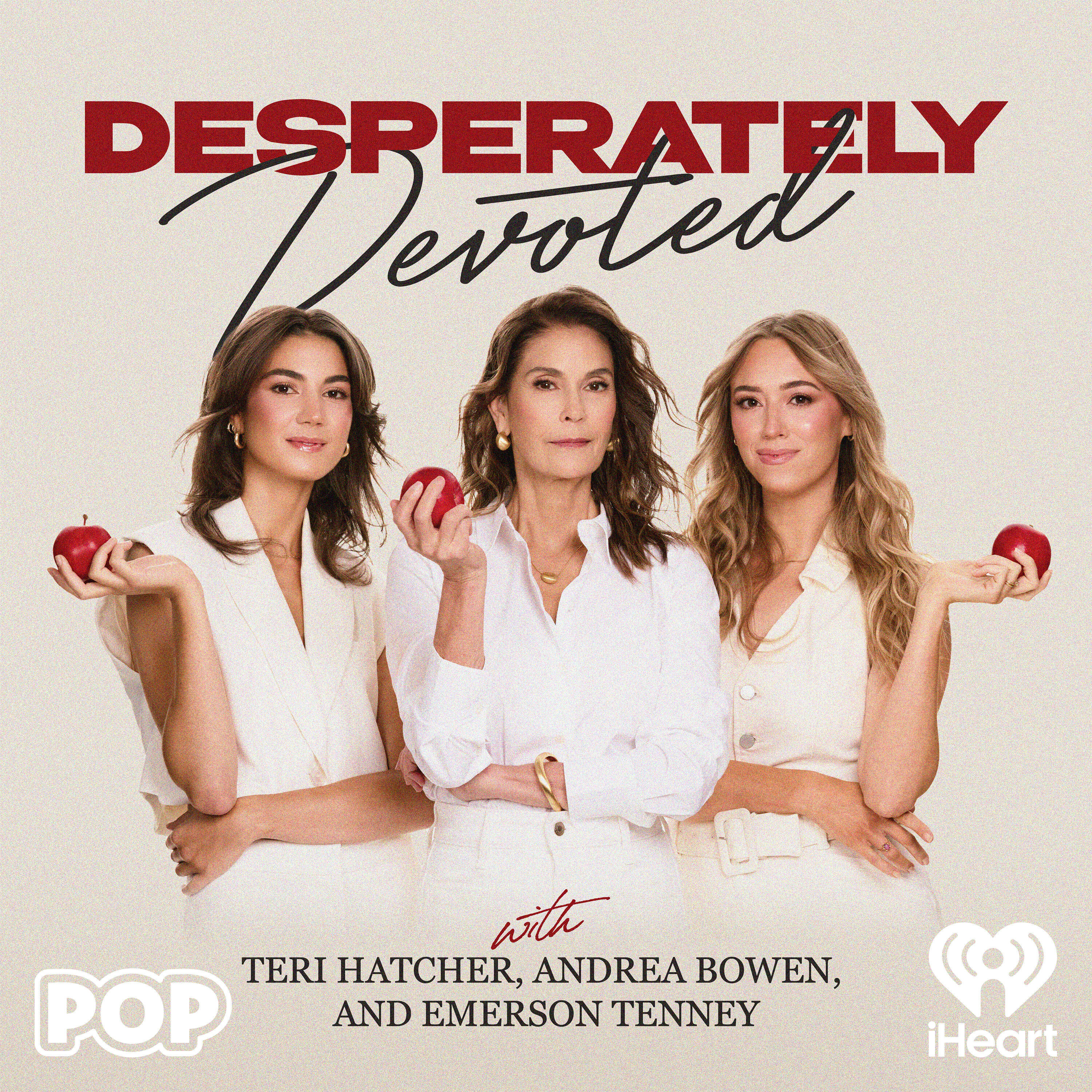
Lies Ladies Tell (S1 Ep19 "Live Alone and Like It")
Dienstag, 24. Februar 2026 · 47 min
Kapitelklicken springt direkt hin
Shownotes
An episode that reminds us that alone doesn’t mean lonely.
The ladies revel in the perks of privacy and finding fulfillment when you’re flying solo. Plus, what women really mean when they say ‘I’m fine,’ AND an Easter egg you probably missed the first time around!
Follow @desperatelydevotedpodcast on Instagram and TikTok
Follow Teri (officialterihatcher) on Instagram, Andrea (andiebo) on Instagram and Emerson (iamemersontenney) on Instagram
See omnystudio.com/listener for privacy information.
Transkriptvom Podcast bereitgestellt · Zeitmarken springen hin
Welcome to Desperately Devoted.
Think of us as your favorite neighbors as we chat about life and relationships, all.
While we revisit the iconic show Desperate Housewives together.
I'm Terry Hatcher, I'm Andrea Bowen.
And I'm Emerson Tenny. Okay, welcome back here.
We are it Desperately Devoted, and we are here for episode nineteen. We live alone and like it and like it.
It's just so aggressive. I know, what do you like from?
Do we know?
You know?
I honestly don't. I don't know. I actually have no idea.
I think so. It aired on April seventeenth, two thousand and five.
Two thousand and five, and we don't know why it's called this, but I mean it does beg the question, and especially it begs it of me because I do live alone.
But I do like it.
I have learned to like it. But I thought, this is like the first really big theme that I think actually a lot of people are struggling with being alone. I think a big theme in this episode period is loneliness, the difference between being alone and feeling lonely. I think those things get conflated a lot. I think people feel lonely even when they're in relationships. So yeah, I was super happy to talk about my journey because I mean, I actually I don't want to say I wear living alone with pride. That sounds that sounds excessive. But I do think I have earned some level of happiness in being alone that has been very conscious and I've worked for And I don't mind like sharing that because I think there are a lot of people who are alone.
I think, you know, the statistic on being a single woman over fifty and ever, the chance of you getting remarried is like eighty percent you will not Oh really, Oh yeah, it's very very high.
Wow.
But also like you can't go through your life like in some state of longing and like less than you know, that's just no fun. So I feel like I've worked really hard at like being social, finding what I'm passionate about, connecting with people that you know, encourage me to do new things, being there for my friends, being there to help people, having people help me, Like, all of that has been very conscious in my experience. That's led me to not feeling lonely.
Right, living alone by choice not by default is different too, like looking at it, like I choose to live alone.
I think it's funny.
Because right before we started recording, I was describing my upbringing and it's very interesting in that I'm the youngest of six kids.
As we know, we have two parents.
For ten years we lived in a two bedroom apartment in Manhattan, so that's eight people in a two bedroom. The logistics of that were insane. So I was never alone. I mean, I was a kid, so that was fine with me. But I've noticed that my siblings and I as we got older, we really do love our alone space. And I think it's because we never had it, like there was no corner to go in and get any privacy.
So I now, of course live with my husband and we're about to have a baby, and so I'm not living alone.
But I have always really.
Will be alone. Again that you will not pee alone, you will not shower alone, you will you will do nothing like it.
But I love my alone time and opposite upbringing only child, I feel like.
To me it is a really sacred space.
And I have lived with people, I have lived with people I have dated before, and I do like it. And I also really I think about the conversation that Mike cous with Deirdre's dad when he finds out that Deirdre is the body in the box.
I mean, so this happens at the very beginning of episode nineteen.
We big reveal that we find out that the dis web it's Deirdre. Yeah, chopped up, I know, it really gruesome. And they say in that conversation how it's difficult to travel in life without a companion, and I think living alone and having a companion you can do both of those things. I mean, I think about what you're saying, Mom.
The idea of our companions being a romantic companion does not always and also a romantic companion that you choose to live with does not always have to be the case. I mean, we have Deirdre's dad clearly thinking about his life companion as his daughter, and I think our friends and our chosen family, and of course our actual family, these are all versions of people that we can find deep, meaningful companionship with to go through life with so we don't end up feeling lonely even if we are living alone.
And this is something that I see also come up in this episode between Lynette's relationship with Missus McCluskey, which obviously we can get into more later, and I think she is one of the most kind of moving speeches Lynette does toward the end of this episode to missus McCluskey that I definitely want to talk about.
Well later, let's talk about that. That storyline between Lynette and missus McCluskey, you know, not necessarily chronological, but I do think it might be the most compelling story that happened in this episode of where at the beginning of the episode, you know, you see that Lynette really can't stand missus McClusky dreaming, yes, so much so that she's daydreaming about the Swedish perfect family with the two twin girls that are eventually going to marry her two twin sons.
And she's really got the whole thing.
A fantastic wedding that she doesn't pay for, right.
Right, you know, when mclusky drops dead and the Swedish family moves in like this is the fantasy. But then McCluskey almost does drop dead, and instead of letting her die in the street, Lynette chooses to go over and call nine one one, and thus this sort of like no good deed goes on punished. There's just a situation for Lynette comes to fruition, and when missus McClusky then sort of over inserts herself in Lynette's life and you can see that she's sort of craving some sort of companionship.
This could really make me get choked up.
I mean, I know, we say no good deed goes unpunished because it is funny and comical that this kind of hated neighbor across the street from Lynette now won't leave Lynette alone after Lynette.
Helps take her to the hospital.
But I really feel, I mean, there are so many studies that loneliness is like an epidemic in the United States right now today, and I feel from missus McCluskey that she is so alone that one person helping her one time. Now she's like unleashing all of the moments she wants to connect with someone. She's bringing her a Tiffany lamp, she's bringing her avocados, She's saying, let's make guacamole together.
But the pronunciation, I just have to note that she said guaca. Molly love so much.
I know at that moment when they're wheeling, you know, they're putting her in the gurney and she's in the back of the ambulance and she asked Lynette to go with her, and Lynette's like, I can, I've got things to do, and then she says, I'm scared.
I know when I could just I couldn't.
Yeah, go ahead.
Well I could tear up thinking about the moments in Missus mcclusky's life that she is just alone in her house all of the time, feeling like she can't open her pill bottles, feeling like she can't and then she grasps on, you know, albeit too hard to the rope of friendship to Lynette. But I wish and I like that Lynette comes around at the end of the episode, because I kind of wished that Lynette had the tools earlier on to say, listen, I am glad that I was able to show up for you in this moment.
I have a crazy, chaotic life. I have all these kids, I have all these things I need to run. I'm not going to be able to be best friends. Let's do our shopping together, let's make guacamalle together. Because I'm just in a different place in my life than obviously Missus McCluskey is. As someone who's probably retired. I wish that she says that sooner. But I think when she ultimately comes back and lets herself into missus McCluskey's house and helps her with the arthritis medication, she hasn't been able to open the door because she hasn't taken her medication, And she says, you know, we are two human beings living on the same piece of earth and helping each other out once in a while is.
The least that we can do.
Yeah. I felt like that was just such a I mean, it might be one of my favorite lines of the whole season.
Yeah yeah.
And also because of the way it resonates in today's society. I mean, it's worth it's worth saying again. And I know you have it in front of you. I have it too. Oh uh yeah, go ahead, Can you say it again?
Yeah?
Well, I'm gonna miss the beginning and the tail end, but that we are two human beings living on the same piece of earth and helping each other out once in a while is the least we can do.
Yeah, And that's that is just I mean, please, if you're listening, take that into your heart and behave that way in your community. You know, she she brings up another thing before she says that, and and they're kind of discussing how much, you know, it's a tough thing when you need help and you don't want to ask for help. And we've kind of touched about this before, but you know, missus McClusky is like, I can open my bottles, but really I can't open my bottles. Remind me of Grandma, yeah, you know, and and me a little bit, you know, and and and Lynette's like, it's just not a big deal. Like you, I'm oblig half of life. Half of life is obligations. And I thought like, wow, is that true? And and and is it bad? I mean,
it's sort of worth looking at, Like it's kind of falls into even like when we're random people say to you, you know, how are you And you're like, I'm fine, right, you know, and but you're not really fine.
I don't say say I stopped doing that.
I started saying the more part to just random fucking people, and you have to say it oftentimes really does open the conversation up to people being like, yeah, I've been having a really hard month too, I you know, because I don't like that the blanket is I'm fine, I'm good, And I actually think it diminishes when you actually are doing good. Yeah, that's our canned response that we say all the time, right when you know whatever, within reasons.
But you think saying I'm fine feels obligatory, feels like something you do to just kind of for you.
Asking how are you? You know whatever, and and lively, you know, open the door for somebody going into the coffee shop, or you know, oh, my neighbor needs me to pull in their trash cans, or like some of these things that idea, that feeling that you have of like I don't really want to be doing this, but I'm going to do it anyway. And I guess I would argue that it's a good thing like that, that your obligatory feelings, if you let them, can lead you to feeling like a good person, Like you know, they can lead you to feeling like I actually did help somebody.
Maybe I didn't even really want to, but like I did, and now that it's over, Yeah, that was good, right, I should have done that, And there can be lessons in it.
I think there can be a.
Lot of joy found in things that we might initially think of as an obligation or something like, oh, I should do this. I'm thinking about the time that I was in London and I was crossing this bridge and I was going to meet at dinner. It's like a long bridge, and I was kind of running late, and there was a woman with a stroller who was clearly struggling to like bring the stroller down the stairs. And I was going up the stairs, and I stopped at the top of the stairs and picked up the bottom of the stroller and we held it and we carried it back down the stairs together, and then I went back up and she was like, oh.
My gosh, thank you so much.
And I have to say, the moments of human interaction you open yourself up to when you let yourself be led by maybe a feeling of obligation of what the quote unquote right thing to do is.
Does enhance your quality of life.
Yeah, I think that's what I was trying to say, said much better.
Well.
I also think it's a delicate thing, the idea of aging and respecting an aging person's independence if they're able to live alone, while also trying to be available to an elderly person who lives alone. So that they have companionship. Right, It's like my grandma is, she'll be ninety two next month.
She is sharp as attack she is.
She's lived alone completely independently for a very long time since my grandpa passed away, which was.
In nineteen ninety seven. I think, oh wow, yeah.
And she has always said to me a few interesting things about that idea of living alone. She feels like it's kept her young. She's not necessarily stubborn about it. She's opened to the idea of when the time comes that she needs more support going in that direction. But another thing that this is sort of tangentially related, but I just thought about it while we were talking, is that when it comes to respecting older people. She said this to me once, and I have thought about it every single other time I've ever encountered an older person, which is that we are so quick to finish their sentences or move the situation on like faster because they might require more time or more patience, And that the
most it is such a It robs you so much in that moment. It sucks so much of your life out to not for someone to not give you the space to finish your own sentence and it's not that applicable to the Missus McCluskey storyline in this episode.
I just was thinking about when you are the person who is in a situation with someone who's.
Older, finish your sentence please, Okay, No, it's right, And I'm going to approach my parents with that. I mean, I do you know, because I've mentioned before that I am kind of right in this situation and there are things like that, like you can't open the bottle, you don't know how to use the television remote, like you know, these sorts of things that seem so easy for me that I can be quick to just I can do it.
I can do it. I can do it. And it is a really good thing to have the patience to let them do what they can do. And I would go back to what you were just saying and then we can move on. But it is in those moments of patience the connection of humanness can reveal surprising things and usually good, rewarding things you didn't expect. And so maybe a little takeaway is to look at what feels like an obligation as a potential opportunity thought and I really good reframe.
I like it, and I think you know, there was a lot of sensitivity given to this idea of human connection and interpersonal relationships, extra sensitivity in this episode, and I wonder, I just have to wonder if this is partially because this episode did have a female director and writer, Arlene Sandford.
Do you remember I'm working with Arlene? I do, because she directed a couple of episodes. Yeah, I seem to recall. You know, I have this weird thing that happens to me with my memory. Well, one is I don't have one. But other than that, when I do remember things, sometimes when they're not specific, they come in a feeling like I've met people in a hallway, you know, and I've just been like the feeling is like I know that I know this person and I have a good feeling, or I have a bad feeling and I don't remember what happened at all. I just have this good or bad.
And when I think about Arlene, I think good. Yeah, I think things like she knew her shit in the comedy Lane. I liked her being a woman. I felt like she knew what she was doing. Like there is a thing in television. I don't know if it happens so much now, but I felt like there was a movement for these sort of guest directors to not actually have very much agency and just kind of being told by the producers what the vision was. And I used to always think that was such a weird thing. It's like hiring a really good actor and then giving them a bunch of line readings, like why would you do that.
You're not allowing the person with the talent to be creative and rise to the occasion and surprise you. You're just telling them what you want them to do. And I kind of feel like that with some of the directors that I know were very talented that came through Desperate House, that some of them were limited in their own ability to sort of shine with what their specific creativity was. Somehow, She's falling into that category for me, but I could completely be making that up.
I also think it's got to be so challenging, and Emerson, I wonder if you have aspirations to do episodic television at all as a director, But I think it has to be so challenging to come into an established show and you've got all these actors who have a lot of knowledge and experience of their characters and you have writers who have been writing these characters, and you have showrunners to factor in. You have all these things, and if you're just coming in for the week, like you said, it has to be a balance of like, I'm coming in with ideas, I'm coming in ready to play and be creative and also know that I'm slotted into an already running machine.
And how does that balance work?
But I'm sure to answer your question, I just have a feeling that she did bring that because I just have good whatever it was, it just feels good. I felt like I remember being happy she was there.
Well, I love to hear that, and I don't you know, I don't personally have a ton I think it is such a specific world and it's such a competitive world to be going out to direct episodic television or any television, and that I'm much more on the feature side of things. I mean, I would approach TV as a writer, but probably not as a director, although I'm thinking, and now I'm like, maybe we have to get her on here just to talk about this very question. A dear friend of mine, Kate Herron, is an amazing director and writer.
She writes both features and TV and directs a lot of TV and she's directed.
She just directed season two.
Episode four of the Last of Us, which was a monster of an episode and.
That was where all the zombies came alive. Was Yeah, and she rushed and I mean there were so many zombies that had to be huge and episode direction.
Yeah, And she's just she's really she's a badass episodic director who goes up for these very specific tonal shows. She's up for another big show right now that I don't think I can talk about. And also has directed episodes of Loki and like these huge worlds where you come in with your particular vision and I just I'd love to get.
Her tell that would be interesting. Well, another really crazy storyline that was happening in this episode was with Brie and Rex and Andrew. And I know that we all have a lot of different reactions.
As a queer in the room, I have things to say that you do. Yeah.
Why are the craziest dinner party scenes always at Brion Rex's.
I mean they are the only people throwing dinner parties except Lynette, which only does it for work or like revenge.
Yeah, well, I guess it's because she's the only one that's good at it. They needed a Terry Hatcher on the show, and then Terry could have thrown competing.
Dinner parties and Susan certainly did not.
Susan did not have those talents.
And a lot less religious judgment. I have a feeling.
Oh yeah, So we've got Bri and Rex that are picking up Andrew at the juvenile detention camp because he has revealed that he's gay, and.
God forbid they leave him around two hundred boys after that revelation.
That's what Brie thinks, and so she wants to get him home. She wants to get him seeing the priest from the church, she wants to get him into Christian conversion camp.
Yeah.
And we find ourselves at the dinner table talking all of this through.
Yeah.
And before that, she says my favorite, and I'm being very very sarcastic here, thing that I think people with more traditional ideas about sexuality say when their children come out, which is, are you sure this isn't a phase?
And then she says, well, I want.
To address this with Christian counseling before it becomes another one of my least favorite phrases, a lifestyle. Wow, And I just think I mean, I will just say as for a moment before we get into the dinner scene, both of those questions is this phase, you know, I want you to be cognizant of this not becoming a lifestyle, which actually we just saw come up on I don't know if anyone watched the current season of Love is Blind, but there are two people on that show who are having a conversation about like their future potential kids, and one of them says, what would you do if your kid was gay? And she was like, well, I would really want to make sure that they knew about what it means to sign up for that lifestyle.
Oh wow, wild wow.
I just it is so demeaning and also diminishing of the idea of if we're talking about this overarching concept of companionship, how it is difficult to go through the world alone, the fact that who you choose to have as a companion, who you love, who you navigate this shared piece of earth, with the fact that their gender would have some bearing on something being a phase or being a negative lifestyle, as opposed to just wow, I'm so happy that you aren't alone in this crazy spinning planet.
To me, is just absolutely atrocious.
And well it comes these the source of these opinions so often come wrapped up in hypocrisy in the first place, right Like bre is coming at this as as speaking as though this lifestyle phase choice that her son is making is something.
There's a lot of quotation for the audience.
Yes, yes, is somehow.
The wrong path is saying that she and Rex's traditional lifestyle is the goal the working Well, it's clearly working out so well for them. I mean, it's it's so not seeing that I just think that is often the thing that makes me the angriest, which is just hypocrisy in general.
But yeah, I mean, and it does come back to beliefs, and I think without I mean, I think I've I've been fairly clear about the fact that I don't have religious beliefs, and you know, I have a virtual sense of my journey through the universe as a human, but I'm not into organized religion. And but I think what you can't argue with, whether you are into organized religion or not, is that you know it comes from belief, not from fact, and so so much of this, you know, the same way I can believe that there isn't the God in the way that Catholicism or or Christianity like says it is. I can't prove that, so don't I don't know, just like someone who does have that belief can also not prove it. It's a belief. And when
beliefs becomes so strong that they hurt other people, that's where I'm out. Yeah, you know, like you can't say that the thing you believe is a strong enough reason to hurt someone else. And that's where I get And I have very caught up in the problematic of this, but I do think again about Desperate Housewives, How great that there's a character representing, you know, a conservative point of view that people have and isn't often on television.
And so we're going to see her struggle and and and express her thoughts, and you know, we're going to see her kind of get her come up and too because Andrew reveals that he has plans to really hurt his mother.
Yeah.
Well, I was going to say I really before that I love Andrew in this scene, this dinner party scene, because we have the priest comes over and they're you know, doing the whole spiel about Prade gayway. Yeah, exactly. Praie gay Away, and Andrew says, I like myself, and Rex also steps up and says, I'm going to love my son no matter what. And I wrote, as I was watching the episode, well, first I wrote you all caps, and then I said, I need to say, do not fucking change if you're gay. If you're gay, you're perfect, don't ever hate yourself. And then I said, that's right, Andrew, I love.
I am an emotional Yeah.
I love that he's able to sit at that table, and he's kind of a character that I think has come across as very cocky and flawed obviously, but in that moment and it doesn't feel spiteful. I think he delivered that so well and earnestly. He goes, yeah, I like myself. I'm not interested in going to your counseling.
I'm perfectly happy with who I am and I'm not interested in changing that because I like who I am. And I just I encourage you if you are living in a state or a country, and there are plenty right now where I think we are hearing the prey the gay away kind of conversation.
You are completely perfect as you are.
And I hope that you know that and that you can and channel some of Andrew's energy in this scene, because yeah, that's just you're great.
So well, Bree does a crazy thing here where she I mean, I just couldn't believe this. Where she compares she says what she thinks is being a good thing. I love you, I would love you even if you were a murderer, as if being a murderer should be compared equalized with being gay. I mean, what are you talking about, lady. And then she also says, which I think is bad parenting. She says, the reason I don't want you to be gay is because you won't get into heaven. And she could have stopped there, like, if you have your religious beliefs, which I've already said I don't agree with, but if you have your beliefs, and your religious beliefs not facts, but beliefs, are that someone who's gay won't get into heaven, Like, okay, you can
say that. But then she says, and all be lonely. And that's when it's like, oh about you. This is about you. This isn't actually about your son. This is about you and what you're not going to get out of it. And so many parents I do believe make this mistake, and they somehow cloak it as loving their children, but it really is about their own ego and their own needs.
And I just have to say, I feel like I've been a little bit hard on Rex throughout this first season, and I think he's deserved it. But I think that he was great in this episode, you know, in terms of representing more accepting father's reaction. You know, we haven't seen him be thrown by this news at all, Like he is kind of just like we love our son well.
As Bries says, it's because he's into.
S and M right exactly, She's like, well, that's because your perverse.
I mean, it's really she needs she needs some help. She needs some help coming around.
We do think they need some help.
Other people need some help just to jump into and this also idea of companionship and what we need from other people. Other people who need help, I would say, is Gabby, Oh my god and Carlos. Carlos refusing to rip up the post nup that he made her sign so forcefully in the previous episode that she had bruises.
All over her wrists.
Gabby has now kind of gone back to her affair with John, and we have Carlos also holding over Gabby's head that he has cut up all of her credit cards and he's not giving her any money.
And can you guys help me?
I'm confused now what's going on with their financial situation? I don't understand, Like, Okay, so now he's he's setting up to go to jail to do the plea for the eight months, but so they've got money in.
The meantime, Well, they got the settlement, they got.
The settlement, but so but they have access to the settlement and and but.
Then also what did she quit the mall makeup job?
Gabby was working at the mall in a makeup store at one point.
And now it's just.
An example of you know what happens when you're writing a series and and you know, you see some showrunners do it in a way where you don't have inconsistencies and questions like this, and then you see some who don't. And it's clearly because there was not a connective tissue, long term arc plan, like a lot of this must have been being written on the fly. And I'm not saying that that makes it bad, because I think you can see in the quality of the show that the overarching goal was to be entertaining, and the and and so there wasn't as much attention paid to the legitimacy of the consistency. I know as an actor, and I'm sure you could ask anybody who was on this show, you know that that it's it's tough because you you
have in your mind a little bit of an idea about who your character is, and then these things they don't they're they're like cards all falling apart, like you don't you know, you look at it and you go, wait, didn't I have a job? I mean I used to say, wait, aren't I a children's book illustrator? And then like, I mean, I think after season one you never saw me draw anything ever again, Like you draw a lot and you know what, but that's gone, Like what happened to that career?
Like you never you never see Susan go to a publisher house or whatever, like her whole job life just went out the window. And you know if like you, I'm not writing it, like I don't have any say in writing it. I just do what shows up on the page. And so, yeah, it is weird. I don't think you're gonna get an answer to the money. But what I do think you might get an answer to, or we could explore that. It's interesting is that Gabby finds herself with John's credit card because he's been he makes so much money as a gardener. Now that he can he can give Gabby loves her so much he can give her the credit card.
Not without his mom co signing on it.
So of course the first thing she does is go out and buy a bunch of expensive shoes. And I wanted to talk to you guys about addiction or like shopping addictions before we talk about that.
Okay, because I think you've moved a little too quickly for me at least. Okay from the Gabby's characters inconsistency in the writing, Okay, you're right. Andrea, she had this job. She was like, honestly really kind of stepping up as a not materialistic person who wanted to take care of herself.
She had that line like don't call whatever you do tonight, don't call me beautiful.
Yeah. I felt like she had a lot of agency. And I was disappointed in the on the fly writing from this because I think it brought us right back to this idea that we've seen Gaby's character struggle with throughout the season, between Carlos and now between Carlos and John, of women needing men for financial support and approval and money.
And we see this again when she goes out to buy the shoes and then John's card gets declined and she happens to be at the expense of lunch and she gets the man across the restaurant to come and pay for her meal. Which I'd love to talk about that, but I was curious, and I'm not trying to derail your question mom about shopping addiction, but I was curious what we think this storyline says about women and women needing men and how does that sit today?
For me?
It doesn't sit well, although I also have been in situations where I've been alone at nice restaurants and a guy has sat down next to me at the bar and we've chatted and he's ended up paying for my whole meal, and I've not ever gone out with him or anything. He hasn't even left his number in certain scenarios, Did you.
Give him a fake name the way the Gabrielle gives No.
I didn't, but I have to say, actually, in the scenario, I'm thinking of this man paying for my meal in a very fancy restaurant in New York. This was many years ago. He was actually so lovely and didn't leave his number and didn't try to ask me out, like he clearly just had a lot of money, and we kind of bonded over talking about food, and I feel like he was doing this gesture to be nice, and it felt a little more like a pay it forward, we're all on the earth in this limited amount of time kind of storyline. But I definitely have primarily negative feelings about presenting female characters this way.
What do you think, well that in general, that idea came up for me in this episode. I didn't love how Brie was behaving and her whole storyline. I didn't love how Gabby was behaving and her whole storyline. I did really like the Lynette missus McCluskey sort of like growth and learning out of that story. But then I found myself going, Okay, you know, back in two thousand and five, the point of like entertainment and shows that you would watch once a week when they came on at nine o'clock on Sunday, night was what I would call water cooler moments where you would go to the office the next day, you would be on your break and you'd get out of your cubicle and you'd go into the coffee break room and you'd be standing around
and people would be like, what did you think of Gabby? And what did you think of Brian? What did you think of Susan? And it gave them something to bond over and complain about, and it gave them a villain to hate and a person to root for and a person to not like. And I think over all that's the point of drama or or comedic drama, that we're not going to like all of this, you know, like that that's like if we liked everybody, if we supported like if Gabby was the like independent woman who was like, fuck you, I'll go get my own money and whatever, that we might want that from up. But then what would we be talking about at the water cooler.
Yeah, I was gonna I was gonna say something similar, which is that we might not like it as three women sitting here as Terry, Andrea and Emerson, but as viewers of a television show, we kind of need it, right, We need. We need flawed characters, We need characters. I also am always team show women as flawed human beings, right, because I think that there's not enough of that in storytelling either.
And so in my own personal.
Life, do I love the idea of a woman not stepping into her own agency and relying on a man for financial support. No, but I my mind, the only reason my spidy senses went up is because I feel like we were getting somewhere with Gabrielle and then it feels like, out of nowhere, she backslit, and that bothers me a little bit. But because you also say it in that consistent because it doesn't feel consistent, and just as an actor, you know you struggle with how do you how do you reconcile those differences when you approach your work.
But we also see it a bit in the Susan Sophie.
Storyline in this episode from the Sophie point of view, right, which is that she is.
Clearly using wanting, craving male.
Attention to fill something up in her life that's missing, and she's kind of trying to get Susan to do that as well and more parenting the men she brings home in the middle of the night, and I know, what are these crazy antics? But yeah, so I think that's another big theme of this episode.
Well, I agree, and I was I was curious what you thought about this when when Sophie is bringing home all of these men and Susan says to her mom, you know you just went through a breakup. Can't you at least pretend to mourn the relationship for a little while? And I thought this was interesting, the idea of how people, because Susan is also going through her heartbreak with Mike, how people navigate heartbreak or disappointment in a relationship Differently, Sophie is clearly for better or worse, and we could get into, you know, psychoanalyzing it, filling this new void in her life with as much different male attention and distraction as she possibly can, and Susan is walls as high as ever, completely closed off from anything, just absolutely
wallowing and isolating.
And I think.
Probably the most healthy approach is somewhere in between those two responses.
But I was wondering, do either of you.
Feel like there is an appropriate way to mourn a relationship or a breakup, or an appropriate timeline to quote unquote get back out there or move on.
Well, I mean that, you know a time where I was broken up with, and I can't really say I was broken up with because it wasn't really like, you know, we had been seeing each other for a couple months, but it wasn't wasn't like we were in some sort of established relationship necessarily. But then there came the point where he didn't want to see me anymore, and I remember being crushed and really devastated. But in hindsight, I would say that that rejection had more to do with me looking at my belief that I was unlovable, you know what I'm saying. Like, so, the pain that comes up when your heart is broken is less about the not having the person anymore and more about the reflection of you by yourself that you now have to look at.
And so I would say that that reflection deserves its time to look at it. And if you go fill the reflection with a bunch of new people so that you don't have to look at it anymore, I think you're doing a disservice to yourself, which is why I'm not a big fan of the hopping from one relationship to the next, because I think each time a relationship ends, within the pain of that is an opportunity for you to look at yourself and go, what did I learn about myself? What do I want for my life? I know we said this a long time ago, and I can't remember what the context was, but I'm a big believer in like, we spend too much time going why didn't he want me? Instead of why did I want him? Yeah?
And I mean it's worth reminding people because we spend a lot of time wanting to be liked and loved by others because somehow we think that's going to fix the part of us that doesn't like and love ourselves. And I would say that Sophie is doing that. Sophie is not looking at but what she's actually done with her life, and so much so that she doesn't even want to believe that so many years of her life have actually gone by, because she's like rejects her own age, yeah, and her own loss of youth. She's like pretending yeah.
I mean.
She has another line in this episode that I wrote down where she says when she's trying to get Susan to go out with her, she says, I'll say, I'm forty two and you can be twenty eight and you know, so, Yeah, I think you're right, And I think that's such a great point. Growing up, I remember there was that Sex and the City episode where they talked about I think Charlotte says that you're supposed to take half the amount of time you were in the relationship to get over the relationship.
Oh yeah, I've heard that.
Yeah, and I think that I don't know where that originated. For me, it came from that episode of Sex and the City. But I've thought about that since, and I think obviously that can be I think that pertains to how long the relationship is, because if someone's in a twenty year marriage, you're telling them that they're supposed to be saddled for ten years before they can move on.
You know, that doesn't really work that that's what they have to do.
That's no looking at anyone for ten years.
Yeah. No, but I think there is no rule. I think it can be brief, but I just think it shouldn't be unconscious, Like I just think you shouldn't just fill the fill the void or the pain with somebody new to just sort of like, you know, pain over it.
I agree.
I've definitely found myself in I think all sides of this position before in breakups, you know, where you go out with someone very shortly after a breakup, and then you think, while you're even on the date itself, like, oh, it's too soon to be doing this, like, I like, what do I want from this? I'm not I'm certainly not ready to be looking for something serious again, and so why am I even here?
Like?
Is it because I'm looking for unconsciously or consciously some amount of validation and this is probably not actually giving that to me. But but then I've also been in a scenario, you know, where you feel like a relationship has been ending, maybe for a long time, and when you finally actually end it, you've moved through consciously and reflected on a lot of the issues of the relationship already, and then maybe you are more open to meeting someone or to getting into something else sooner.
The last relationship the idea and kind of what I was hearing you say, Terry is it's like focus on whether or not you're putting a band aid on your heart or if you're actually healing.
Yeah, yeah, beautifully, sure, I mean the last relationship I was in, which was like six years ago. I really tried, like one hundred percent tried, Like I packed all my luggage and I moved to another country, and I was like, I'm gonna be both feet in and I'm gonna try to do this. And when I realized it wasn't gonna work out, I so quickly was able to get out of it and not be broken hearted because I'd really tried. Yeah, like I and and so I was like ready for it to be done because I felt like, oh, I went one hundred and fifty percent exploring this, and so I actually didn't have any pain about ending it. You know, But wait, can we just go back to the addiction.
Oh yes, therapy.
I just have to say I realized that the title live Alone and like it comes from the Warren Baty film Dick Tracy from nineteen ninety, which was composed by Stephen Sondheim.
Well there you go.
So just so you know, we still have our we still have the song time. It wasn't a Donna in that movie. I think Madonna was in that movie really yeah, and the Dick Tracy in fact, I think maybe they dated or something. Oh wow, Oh this is another deep dive.
Okay, Well, okay, so retail therapy.
No retail therapy or I have a trick. I just wanted to share because and if Gabby had known this trick, she might not have had to like suffer through uh lunch with the old guy so he would pay for her lunch.
Don'tine to know the trick?
Well, my trick is that I do agree that shopping retail therapy can be some sort of quelling to your stress or you know, lack of control or whatever.
Peple getting those dopamine heads.
Yes, But what I do where I find the dopamine and it works, it's good enough for me, is that I go on the computer and I go to like let's say, I go to the real reel okay, and because a I feel good because it's used and it's recycled and it's good stuff, and it doesn't bother me that it's used anyway. So I'll go through and I might spend an hour like scrolling, and I'll put that in the cart, and then I put that in the cart, and then I put that in the cart, and then I just never buy the stuff in the cart, and so something about it is enough. The dopamine of just moving the stuff into the cart. There's like there's like enough time that I feel like I bought it. But then by the time I'm done, like, I'm like, I
don't have to actually buy that. So yeah, and then I was then and then somehow I've got my fix. I didn't waste any money, and I walk away and I feel better.
I think that I think that tip is a great place to leave it.
Okay, I really think it is the only other thing I'm going to add, just while we're on this piece of earth, as two human beings trying to help each other out once in a while or three, but voting, I got it, as however, many human beings, as you are in a room with on this piece of earth, trying to help each other out. Reverend Sykes, who makes the kind of atrocious comments at the dinner party with Brie, is from the local Presbyterian Church, and the Presbyterian Church of the United States of America in twenty fourteen voted to allow same gender marriages, making it one of the largest Christian denominations in the world to openly accept same sex unions.
And so I just think this.
Is a a good example of how this episode aired in two thousand and five, and nine years later, we see progress happening. It's possible to make the world a better place, and it's possible to not buy all the things in your shopping cart.
Yeah, we don't title this one shopping carts and Healing hearts. I don't know what we're doing.
You're so good, Okay, Well, I loved that episode. There was a lot in that one. I feel like I might have to listen to it myself, just for a reminder of the takeaways that I'm gonna need because there's probably more in the whole alone thing, and as always as the resident alone Liver, I feel like I have more to learn and more to say. So anyways, on that note, come back next week because we are always desperately to you.
