

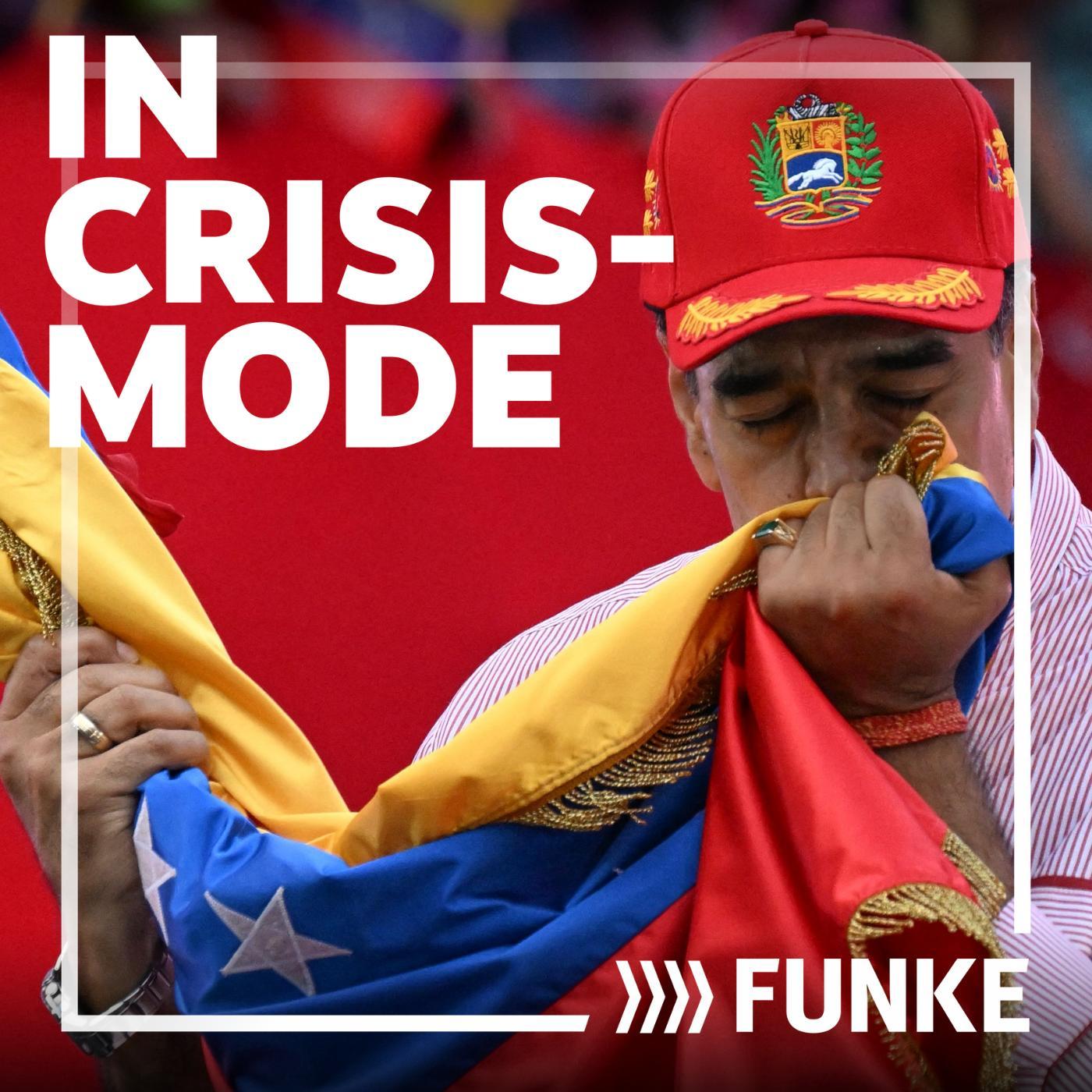
Im Krisenmodus· Folge 125
Caribbean Tensions Rise: Venezuela Between Invasion Threat and Bluster
Mittwoch, 10. Dezember 2025 · 35 min
Kapitelklicken springt direkt hin
Shownotes
U.S. Warships in the Caribbean, Dozens of Attacks on Boats, a “Closed” Airspace – and in Caracas, President Maduro Is Mobilizing Militias. Is an Invasion happening?
FUNKE-War Reporter Jan Jessen talks in this episode of the podcast In Crisis Mode with a German who has lived in Caracas and a Latin America expert about daily life, the 2024 elections, drug-related accusations, international law, oil—and the question of what could really happen next.
Guests:
Dr. Claudia Zilla – Senior Fellow, Americas Research Group, Stiftung Wissenschaft und Politik, Berlin
Jörg Bütefür – Geographer, Venezuela expert since 1988, lived in Caracas 2018–2024
🧭 Chapter Overview
1 – Escalation in the Caribbean
USS Gerald R. Ford, attacks on boats, airspace warning, Trump–Maduro phone call, OPEC assistance
2 – Daily Life in Caracas
Security, “We’re taking the city back,” risk perception, prices and incomes
3 – Drug Allegations and the “Sun Cartel”
Transit hub rather than producer; loose networks rather than a hierarchical cartel
4 – Elections, Opposition, Sanctions
2024 not competitive; regime logic based on incentives, repression, and apparatuses
5 – Economy and Humanitarian Situation
Stabilization vs. multidimensional poverty, weak basic services
6 – Region, International Law, Oil
Uncoordinated region, illegal attacks on boats, dependence on oil – U.S. as buyer
7 – Maduro Scenarios and Outlook
Exile, arrest, targeted killing? Trust, risks—and why democracy must emerge from within
🤝 More Information
Federal Foreign Office
Current travel and safety advice for Venezuela.
🔗 Website: auswaertiges-amt.de
📬 Contact & Feedback
Questions, criticism, suggestions? Write to us:
✉️ krisenmodus@funkemedien.de
🟢 Subscribe Now
In Crisis Mode – available wherever you listen to podcasts:
Spotify (open.spotify.com/show/0IQW1w25NYSrz60aAPzwvB?s…) | Apple Podcasts (podcasts.apple.com/de/podcast/im-krisenmodus/i…) | Deezer (deezer.com/de/show/3737197) | YouTube (youtube.com/@Krisenmodus-Podcast_FUNKE)
📅 New Episodes
Every two weeks, on Wednesdays.
In Crisis Mode is a podcast by the FUNKE Media Group.
This episode was made with AI.
Transkriptvom Podcast bereitgestellt · Zeitmarken springen hin
US warships off the coast, more than 20 attacks on vessels, over 80 dead. The airspace is closed. Is Venezuela facing an invasion? Or is this political theater with deadly consequences? I think Venezuela needs a democratization process that draws its main momentum from within the country itself. But I am not very hopeful that an external intervention, and even less so a military one, will bring a peaceful and sustainable democracy to Venezuela.
... eine friedliche und nachhaltige Demokratie nach Venezuela bringen wird. Musik, In Crisis Mode, the podcast from Conflict Zones with Jan Jess. Welcome to In Crisis Mode. I'm Jan Jessen, Head of Politics at NRZ and Crisis Reporter for the Funke Median Gruppe. Since September, US units have repeatedly attacked boats off Venezuela's coast.
By now, dozens of people have been killed. The official justification, the fight against drug trafficking. In the Caribbean, the USS Gerald R. Ford is positioned, the largest aircraft carrier in the United States. Von der US-Perspektive, die Airspace ist geblieben. Caracas hat mit mobilisieren und Militärer gestorben.
Was bedeutet das für die Menschen auf dem Boden? Und was ist das politisch? Trump has spoken by phone with Venezuelan President Maduro, but details remain undisclosed. There are rumors and media reports suggesting he urged the Venezuelan leader, an autocratic ruler, to step down. A US Senator has even spoken of an offer to leave the country.
At the same time, the United States considers Venezuelan airspace closed, while Caracas has asked OPEC for political backing. Before we dive into this political game or political showdown, I think it's worth first looking at daily life for people in Venezuela. And Jörg Boutefuhr is our first guest. He's a diplomatic geographer from Essen and has known Venezuela since 1988.
From 2018 to 2024, he lived in the capital, Caracas. He describes how the city and its sense of security has changed. The first time I was in northern South America was in 1988. in Venezuela. Ich habe wirklich das Land gefühlt. Und seit Jahren später, wenn die Frage der Frage an, wo meine Frau könnte, als eine Teacher, und Caracas war eine Option, ich habe tatsächlich gewonnen, dass meine Freundin eine Chance gewonnen hat.
So, von 2018 bis 2024, wir waren in Caracas. Meine Freundin worked in der deutschen Schule dort. Ich war sofort auf dem Weg. Und in 2024, wir zurückgekehrt, weil hier noch ein Vertrag rief, der erfüllt werden musste. Also als wir 2018 gekommen sind, war die Situation eine ganz andere noch als 2024, wo wir gegangen sind.
2017 soll ein Jahr gewesen sein, wo es eine heftige Krise gab. So when we arrived in 2018, the situation was still very different from 2024, when we left. 2017 had been a year of severe crisis, also economically, with shortages in supermarkets and so on. By the end of 2018, when we arrived, that was no longer the case.
You could buy everything normally. Of course, like in many Latin American countries, there were extreme differences between rich and poor. We were in a bubble of the wealthy or middle class, which was also required because we worked at the German school. Over the years, however, the security situation improved dramatically, as we already noticed this in 2019.
And before the pandemic broke out, it was possible to move around large parts of the city alone at night without problems. The pandemic then contributed to many people, who had previously been involved in crime and saw no opportunities in the country leaving. Many went to Ecuador, many to Peru or Chile.
And another part, this is a little joke we always make, the motorized criminals who used to drive around streets and steal people's phones now simply deliver food. Restaurants had been closed for a long time. People still wanted food from restaurants and so a large part of these people is now employed by various delivery services.
Mittlerweile in Lohn und Brot bei irgendwelchen Lieferdiensten. Kurz vor Ausbruch der Pandemie gab es so eine Bewegung, die nannte sich wir holen uns unsere Stadt zurück. Shortly before the outbreak of the pandemic, there was a movement called We're Taking Back Our City. This was a story that cut across almost all social layers, where people would consciously go out at night in groups, visit a few restaurants, bars and pubs, and simply use the protection of the group.
This was also taken up by many cultural initiatives, which then offered more city tours and guided walks. You always have to keep in mind that there had been a severe economic crisis, Especially the years 2015, 16 and 17 were extreme. Many places, museums, the Botanical Garden and so on were closed. There were areas where it was really like the Wild West, places you definitely wouldn't go to at that time.
And gradually these areas were revived. For example, at the beginning of 2021, we attended the first guided tour of the Botanical Garden after it had been closed for three years. The Botanical Garden had been a haven for criminals and drug addicts and the police station that was supposed to be there had been closed for several years.
The facilities were partially devastated, but they were painstakingly restored. Today the Botanical Garden is a showpiece where people can visit normally and regular tours are offered. This is simply the kind of transformation that has taken place. Das ist einfach dieser Wandel, der da stattgefunden hat.
Bütteführer also says that the perception of risks is politically charged, politically contested. That even applies to the way people deal with travel advisories. Der deutsche Botschafter Volker Pellet, as he is currently called, travels a lot in Caracas, but also throughout the country. He is an avid motorcyclist and regularly posts about it.
Last week he climbed the main hill of Caracas with a German organist who was visiting, accompanied by his wife, I believe, and one other person. And yes, it was all very relaxed. The current Interior Minister, Dostado Cabello, used this post by the German Ambassador as an opportunity to repost it and raise the question of how credible the recommendations issued by the German Foreign Office really are if the German Ambassador himself wanders alone through nature.
Der alleine durch die Natur wandert. I had read a lot about hyperinflation, I had read a lot about mass impoverishment. But you say that this isn't fundamentally the case. On the contrary, some things have improved, and I found that really fascinating. Overall, over the past five years, there has been a significant improvement in the economic situation.
But it is still the case that poorer people have an income that barely covers their living expenses. People have their apartment or their own house, and they can buy their food. But beyond that, there is not much room for anything else. We're talking about a monthly income in the range of $200 to $400.
This will be the case for a very large part of the population. Living in the countryside or a small town makes it easier to manage than in Caracas. Caracas has a price level similar to Spain. Und dann, natürlich, da ist eine Mittel-Klasse, die nicht so groß ist als in Europa, mit innen von rund 800 bis 1,000 Dollar, und eine sehr klein, sehr wehltige Oberklasse.
Das ist die Perspektive von jemandem, die in Caracas leben hat, der Kapitel von Venezuela, für einige Jahre, Jörg Bütteführ. I've known Jörg for quite a while, back from my time as a local reporter in Essen. We're on familiar terms, and I know he leans left politically, and perhaps, without meaning to be disrespectful, he may also be wearing rose-coloured glasses.
That's why we also spoke with an analyst and asked ourselves, why is there this US pressure right now? What is myth, and what is fact? How stable is this system, the system that emerged from the Bolivarian revolution, Chavismo, Even though it's a politically charged question. For that, we spoke with Claudia Ziller. She's a senior fellow in the Americas Research Group at the Stiftung Wissenschaft und Politik in Berlin.
She's been observing Venezuela for many, many years from a scientific perspective. Of course, I also asked specifically, what's actually true about the story that Venezuela is the main drug-producing and exporting country? Das ist die currente accusation, und Sie haben es in den News gesehen, das ist warum die US ist vom Böden auf der Venezuelan coast.
Die US sagt, in essence, das ist ein Kampf gegen die Drugs, gegen was sie called Drug Terror. Ich finde das ein sehr interessantes term. Es ist nicht nur Drug Trafficking. Die US now hat es als Drug Terror, das die Flügel und die Lande threatens, und das ist die US-Narrative, hence die Angelegenheit auf die Boas.
Und das ist was ich direkt gefragt, ist das eigentlich correct? Ist Venezuela wirklich die Lande der USA mit Drugs? Diese Informationen sind alle widersprüchlich und passen auch mit verschiedenen politischen Maßnahmen der Regierung und Trump nicht zusammen. All this information is contradictory and also does not align with various political measures of the Trump administration, if I may unpack it.
Looking at cocaine production, the main countries are Colombia, Bolivia and Peru. Das heißt, Venezuela ist nicht von den Fentanyl. Fentanyl ist synthetisch, seine Produktion funktioniert anders. Und für das, Sie brauchen eine plant. Aber Fentanyl-trafficking happens mainly auf der border zwischen Mexico und den USA.
Und Fentanyl erreicht die USA, auf der Pacific Route, nicht die Atlantik. So, auf die Drug-Produktion und Trafficking-Routes, Venezuela ist nicht auf der Center. Venezuela ist mehr ein Transit-Country für die Drugs, und mehr für diejenigen zu Europa. Aber auch da, es ist nicht auf der Forefront. Über den Atlantik.
Also das heißt, wenn man sich die Drogeproduktion und die Handelswege anguckt, steht Venezuela nicht im Mittelpunkt. Venezuela ist für Drogen eher ein Transitland und mehr für Drogen, die nach Europa kommen, aber auch nicht an vorderter Stelle. From Dr. Ziller's perspective, that seems at least partly a pretext.
Venezuela is not the main drug-producing or exporting country in Latin America. She points to countries like Colombia and Mexico, other countries but not Venezuela. So this appears, at least in part, to be a pretext to put pressure on Venezuela or to attack it. She also spoke about this so-called cartel. You may have heard of it.
It's an alleged drug cartel in Venezuela that is now considered a terrorist organization by the US. Aber in reality, es ist nicht wirklich ein Kartell. Es ist sozusagen ein hohes Netzwerk von militärischen und civilianen Aktoren die sich über die illegalen und legalen Markets befinden. So, es ist nicht ein klassisch-drug-Kartell wie man von Mexiko oder anderen Ländern kennt.
Another reason often cited for this U.S. aggression toward Venezuela is the contested 2024 election. In July 2024, elections were held in Venezuela. Maduro declared himself the winner. Observers from the U.S., the European Union, and other Latin American countries expressed serious doubts about whether the election was conducted fairly, raising concerns about possible fraud.
There were nationwide protests, reports of arrests, and incidents of violence. Und der Hauptdiskut bleibt. Die Erektoren wurden nicht verlassen. Und es gibt sehr viele Wälder, ob Maduro, der jetzt Präsident der Venezuela für 12 Jahre, die im Juli 2024-Elektionswahl gewonnen hat. Gab es davor vier Wahlen innerhalb der Opposition und Siegerin dieser Vorwahlen unter sehr schweren Bedingungen war Maria Corina Machado.
So wurde sie Kandidatin der Opposition, aber die venezolanische Wahlbehörde Prior to these presidential elections, there were primary elections within the opposition, and the winner under very difficult conditions was Maria Corina Machado. She thus became the opposition's candidate, but the Venezuelan Electoral Authority, in a country that is an autocracy, revoked her permission to actively participate in the elections.
As a result, the opposition, which had democratically chosen its own candidate, had to repeatedly nominate a replacement. I say repeatedly, because Edmundo González, who was eventually officially recognized as the candidate, was not the opposition's second choice. There was another name in between, which was also not accepted by the electoral authority.
This already shows that the conditions under which the elections were held were not competitive. The big question was always whether there would also be fraud in the counting of votes. Since voting and counting in Venezuela is electronic, it was claimed that fraud would not be possible. However, it is assumed that fraud did occur.
The opposition and various citizens acting in a monitoring role during the elections could credibly show that the opposition won with over 60% of the vote and that Maduro lost. The government claims the opposite, that the incumbents clearly won, but they are unable to present the records to prove this result.
All evidence points to not only autocratic manipulation of the election conditions to make victory difficult, but also to an actual opposition win that was not recognised. Without the government being able to prove the opposite, mit Rekord oder Fakten zu zeigen und dann mit den Akten dieses Ergebnis zu belegen.
Alles spricht dafür, dass hier nicht nur. Dass es autokratisch mit den Bedingungen der Wahlen umgegangen ist, um der Position einen Wallsieg zu erschweren, sondern dass es tatsächlich einen Wallsieg gab, der dann nicht anerkannt wurde, ohne das Gegenteil mit Akten, mit Fakten beweisen zu können. So, obviously, at least according to Dr.
Zilla, but also many other observers, these elections were not conducted properly. And yes, it has become a very autocratic regime, you have to say. Nicolás Maduro, the president of Venezuela, has Das hat sich bereits mit dem Land in Autocracy angefangen. Das hat bereits angefangen unter Hugo Chávez, der, unlike Maduro, war sehr charismatisch.
Jetzt scheint der Land zu fliegen weiter in Autocracy, vielleicht eine Diktator-Ship, wo die Intelligenz-Services haben ihre Handen auf alles in der Land passiert. Die Militär ist extrem powerful, und andere Sicherheits-Force, wie die Polizei, sind die Städte-Kontrollen. Since 2015, there have already been attempts at sanctions.
Back then, there was also criticism of the elections or allegations of fraud, and attempts were made to bring about regime change through sanctions, as we know. So for 10 years, these sanctions have been in place, but they don't seem to really challenge the system. This may also be because Russia and China support the country.
Not only that, but as a major oil exporter, Venezuela also earns foreign currency through sales to the US and other buyers. Moreover, the government and the security apparatus are very closely intertwined. They benefit from the regime and naturally, they have a strong interest in preserving it. Sanctions are nicht dafür bekannt, zum Erfolg zu bringen bei dieser Art von Zielen.
Also das ist an sich ein Problem von Sanktionen. Sie können den Druck erhöhen, aber nicht zu einer bestimmten, deutlichen Handlung zwingen. Sanctions are not known to succeed in achieving these kinds of goals. That is inherently a problem with sanctions. They can increase pressure, but they cannot force a clear, decisive action.
The strength of the regime lies in the very close cooperation between civilians in the government and the military and in a system of rewards and punishments that creates incentives for these government members to remain loyal. There have repeatedly been purges within the ranks. People have been convicted, arrested.
There is also torture in Venezuela, not only against opposition members, but also against those who have failed to demonstrate loyalty. The positive incentives consist in allowing individuals to participate in corruption and enrich themselves. This combination of incentives, both positive and negative, has ensured that everyone has something to lose if they switch sides.
What has also been shown so far is that whenever external pressure has increased, cohesion within Venezuela has also strengthened. When outside pressure rises, internal solidarity grows. I cannot recall any fractures that were externally induced. Was ich Zeit hatte, ist, wann immer der Druck von außen erhöht wurde, der Zusammenhalt innerhalb Venezuelas wurde auch stärker.
Also ich kann mich an keine Brüche erinnern, die extern induziert wurden. Jörg Bütteführer describes full supermarkets, albeit with tight budgets, but he says that basically the economy is on the rise again. Dr. Ziller puts this in context and says, well, there may have been a bit of stabilization, especially over the last one or two years.
Hyperinflation is also gone. It was, at times, completely insane in Venezuela, with inflation over 10.000% or more. But despite that, poverty and weak basic services remain the reality. Oft ist es eine Frage des Vergleichs und des Parameters. Also es gab 2024 eine Verbesserung im Vergleich zu einem Jahr davor.
Also das heißt, dass im letzten Jahr. Often it is a question of comparison and parameters. So in 2024, there was an improvement compared to the year before. That means that last year, due to lower inflation and higher oil production, people experienced an improvement. This improvement also stemmed from a certain stabilisation.
Stability, being able to plan at all, is very important. Of course, this stability becomes fragile in situations like the current one. But surveys or social analyses, such as the Kobe University Survey, provide numbers for the last year showing that nearly 60% of households live below the poverty line, or more precisely, in multidimensional poverty.
That means poverty that is not only due to low income, but also includes lack of access to healthcare, education, housing and so on. So, more than half of the population, or households to be exact, live in poverty. Yet even a small improvement becomes very important and noticeable for people in everyday life.
But the situation is critical. Hospitals cannot provide adequate basic services, not even basic, let alone high-quality care. The statistics and surveys point to an already critical situation. Die Statistiken und die Umfragen weisen auf eine schon kritische Lage auf. Der aktuellen Konflikt also affects die Region beyond Venezuela, die in den letzten Jahren in den letzten Jahren struggled sich um sich organisieren und sich entwickeln gemeinsame Positionen.
Es ist nichts wie eine Europäische Union in Latin America. Die verschiedenen Ländern arbeiten sich gegen sich, eher zusammen zu arbeiten. Das hat sich intensiviert über die letzten paar Jahre. Geopolitisch, die Importanz der Latinamerika hat auch declined. Dr. Ziller zeigt das auch. Weil es bleibt schon eine Frage, wenn die USA intervenieren sollten, wie werden die anderen Regierungen der Region reagieren?
Bedauerlicherweise... Denn es bleibt eine Frage, wenn die USA zu intervenieren, wie die anderen Regionen in der Region reagieren würde? Unfortunately, Latin America ist nicht sehr gut geordneten. Regional Organisationen sind in eine crisis, in der sich, dass sie in der Lage sind, und sie können besser initiieren, finden agreement über ideologische Boundaries.
Und das ist nicht mehr so. So political coordination within the region is currently very low. And very often political or ideological sympathies decide positions rather than reference to international law or democracy. Sehr oft, ja, politische Sympathien, ideologische Sympathien über Haltungen in einem Staat, dass man sich auf das internationale Recht oder auf die Demokratie bezieht.
Yes, and I think it's really important to say this. According to virtually all observers, the US, by attacking these so-called drug boats, these alleged drug boats, is committing violations of international law. You simply can't carry out extrajudicial killings against people you don't even know, whose names you don't have.
Instead, you just say, okay, it's a boat out there, allegedly carrying drug traffickers on board. We don't even know the names of these people. They haven't been legally convicted or anything. So they are declared terrorists and what they're doing is labelled a terrorist attack against the US From an international law perspective that's already a very very risky claim and basically all outside observers say that what's happening right now is illegal under international law and of course that would also be the case if the US were to step up its attacks Donald Trump has talked about possibly attacking on land The forces the US has assembled include not just the aircraft carrier USS Gerald R4 aber auch destroyers und landingshäuser für mögliche Amphibien operativen,
Das ist, dass die Angelegenheit auf den Tafeln ist. An Angelegenheit auf lande würde definitiv ein Krieg gegen eine Sovereinheit und wäre incompatible mit internationalen Law. Die ironic, though nicht wirklich funny, ist, dass, despite all diese Angelegenheit gegen Venezuela, despite criticism von den Regime, despite die obviousen Efforts zu bringen über Regime Change, und despite die Claim, dass die Venezuelan-Leaderschaft ist für die USA, Die USA ist noch ein großer Bauer von Venezuelan Oil.
Despite all die Sanctions, die USA ist der Hauptpurchase der Venezuelan Crude. Und auf der anderen Seite, es ist auch wichtig, dass die USA ein großes Arme gibt, besonders zu Ländern bordering Venezuela. In der Ende, das kann auch die Probleme zu verändern, die in diesen Ländern existieren. Dr. Ziller points this out as well. Autark ist es nicht. Venezuela braucht jemanden, der das Öl abnimmt.
Venezuela braucht selbst nicht so viel Öl. Und die einzige Ressource ist Öl. Die Wirtschaft ist darauf konzentriert. It is not autarkic. Venezuela needs someone to buy its oil. Venezuela itself does not consume that much oil. And oil is its only resource. The economy is focused on it. There is no industrialisation, no diversification.
Therefore, Venezuela is heavily dependent on two things. First, that the oil is extracted, and second, that it is purchased. Trump, albeit with limitations, allowed Chevron to operate. Venezuela's main trading partners are the US, with China in second place. Of course, China is a very important buyer of oil, but so are the US.
Because of arms embargoes and sanctions, the weapons or military equipment Venezuela needs come from China and Russia, not from Western countries. But it's also not the case that the armed forces are very well equipped. The military is neither professional nor efficient. There is limited funding and some chaos within the regime, albeit with strong cohesion, as I mentioned before.
Ein bisschen das Chaos innerhalb des Regimes, wenn auch mit hohem Zusammenhalt, wie ich davon gesprochen habe. As we just discussed, are the Venezuelan armed forces actually capable of repelling an American attack? I would express similar doubts. The regular forces are said to number 123.000 active personnel.
On top of that, there are supposedly 6 million volunteers, a kind of reserve militia. Und jetzt hörst du, dass sogar die Reise und andere Zivilisationen sind, obwohl es rudimentarisch ist. Ob sie eine US-Invasion, besonders eine von den Erinnerungen zu unterstützen, ist eine große Frage. Und die große Frage ist auch, was eigentlich mit dem Regime passieren würde.
Denn, als war sehr klar in unserer Gespräche, der Regime ist nicht nur Maduro selbst. Wenn Trump und Maduro haben eine Telefonkarte, als es in den Medien berichtet, Trump admitted dass es zumindest einen Kontakt war, während er allegedly asked Maduro zu resignieren, die Debatte bleibt. Könnte Maduro und seine Familie gehen in Exile, e.g. in Russia, ein close-hierer Venezuela- oder könnte ein Scenario unfold similar zu was mit Noriega in Panama in 1989, when the U.S.
Launched a landing operation citing the country's role in drug trafficking. Noriega was portrayed as a major drug trafficker, was deposed, kidnapped, and tried in the U.S. That's a scenario one could imagine here. Or another possibility, hinted at by the deployment of U.S. Drones in Puerto Rico in recent days, is that Maduro could be targeted for elimination.
But none of this would actually dismantle the whole regime because, as made clear, the regime rests on very broad shoulders. Maduro is essentially just the front man. At the end of the day, many people have a vested interest in keeping the regime in place. I mentioned earlier the so-called Sun Cartel.
This isn't a classic drug cartel. It's not a formal organization, but a network of many people who have a strong interest in preserving the regime as it is. So even if the head is removed, the regime itself would likely remain. That's the big question. Dr. Zillah also pointed out something I found very interesting. The population is deeply divided.
Of course, there are people who want the regime completely gone. The opposition generally wants the regime removed. But the big question is how that could happen. And there are many people who don't want a regime change imposed from the outside, as for example Maria Corina Machado advocates. There's a certain irony here. Last year she was barred from running in the presidential elections, Yet this year, she received the Nobel Peace Prize, and now she calls for a military intervention in Venezuela, But the opposition doesn't seem to be united on this. And then the question arises, what actually happens if there is a regime change, if Maduro is overthrown?
Would the country descend into chaos? Would there be civil war-like scenarios? We've seen this before in other regions like Iraq or Libya, where the violent removal of dictators actually worsened the situation for the population. I also asked Dr. Zilla what she thinks will happen. What will Maduro do?
Can he trust the promises made regarding exile abroad? Ich denke, das hängt vom Vertrauen ab. Also Feinde können ein großes Vertrauen zueinander haben, aber auch nicht. Und es ist die Frage... Ich denke, es muss sich auf die Hoffnung auf die Hoffnung haben. Die Hoffnung kann sich in die Hoffnung haben, oder nicht.
Und die Frage ist, wie viel Hoffnung hat, in Trump's promises? Kann er auf sie rely auf sie? Ich glaube, das wird sich definitiv, wenn dieser Offer eine Rolle spielt. Er versucht, in der Zeit, in der Zeit, so dass die Leute wissen, dass er nicht weg oder weggekehrt hat. How reliable are Trump's guarantees for Maduro? I would have my doubts in his place.
That's why I think a safer path would be to leave the country first and then say, okay, I'm already gone, rather than agreeing to be extracted. Ein sicherer Weg wäre zunächst mal aus dem Land zu gehen und dann zu sagen, okay, ich will schon weg, als dass er sich darauf einlässt, dass er rausgebracht wird. What happens next?
What would the US gain? because the regime, as Trump himself has noted, has no inherent interest in dissolving itself. That probably won't happen. This means the opposition would have to rise up against the forces of the regime which have entrenched themselves over the past 25 years. Personally, I find it rather unlikely that a regime would simply step aside, surrendering its power just because Maduro is removed, who, according to many observers, plays a relatively minor role and is essentially just the front man.
So, the entire regime would have to be dismantled. And that, of course, brings the Damocles sword of a larger war or conflict, raising questions about whether the opposition could withstand it. Is the opposition armed? Have the US possibly armed opposition forces? Could this all fall into a security vacuum, leading Venezuela and perhaps Latin America into a scenario similar to what we've seen in Libya or Iraq?
Das wäre catastrophisch, als diese Länder suffered years von civil war und aufgehörigen instabilität. Und Venezuela natürlich nicht will das, als Dr. Ziller pointed out. In der ersten Zeit, der beste-case-scenario wäre eine demokratische Prozess, eine Bewegung toward Demokratie emerging von within den Land selbst.
External-militär interventions sind immer ein major Problem. Moreover, was die US jetzt weiterverkommt, die es imidisch globalerweise verletzt war. It was already not as strong as it once was, but these attacks on boats, these threats, the unvarnished threats of regime change, they only worsen the perception.
I've also wondered whether there might end up being a laughing third party in all this. China, the country gaining ever more global influence. Naturally, one could imagine that Latin American countries might lean toward China if the Americans cannot be trusted. Wenn die USA, über minor pretexten und vielleicht für selbst- Interesse, wie die Veränderung zu Venezuela, starten Konflikt, dann können die Länder lieber zurückkehren zu China.
Öl ist ein wichtiges Problem hier. Venezuela hat die größte Öl-Reserven in der Welt, rund 300 Billionen Barrels. Wenn das ist, es könnte auch ein Grund dafür, dass Washington für Regime-Changehörter, um größte Öl-Reserven zu erhalten. Dr. Ziller noted that this is certainly possible. It may not just be economic reasons motivating the Americans but also a desire to assert dominance over the continent as a counterweight to China.
China is gaining influence and the US may be attempting to reassert its dominance. What I also find interesting is that this seems like a return to what we saw in the 1970s and 1980s when the US repeatedly instigated regime changes in Latin America before turning its attention to the Middle East. In my view, the transition to democracy in Venezuela must come from within, ideally integrated with regional frameworks and supported internationally, but absolutely not through threats, landing plans or military operations.
Military operations, as we've seen in many countries, rarely produce good outcomes. They bring suffering, destruction and long-term instability. Venezuela and Latin America simply cannot afford that. And that's what the region really hopes to avoid. Das episode von In Crisis Mode war von Alexander Baumeister, who ist auch ein Journalist von Funker Medien Gruppe.
Wenn du dieses Podcast gefallen hast, schreibt uns, schreibt uns, und schreibt uns, oder schreibt uns zu Chris & Modus auf funkamedian.de. Vielen Dank für die Zuschauen. Take care. Musik.
