

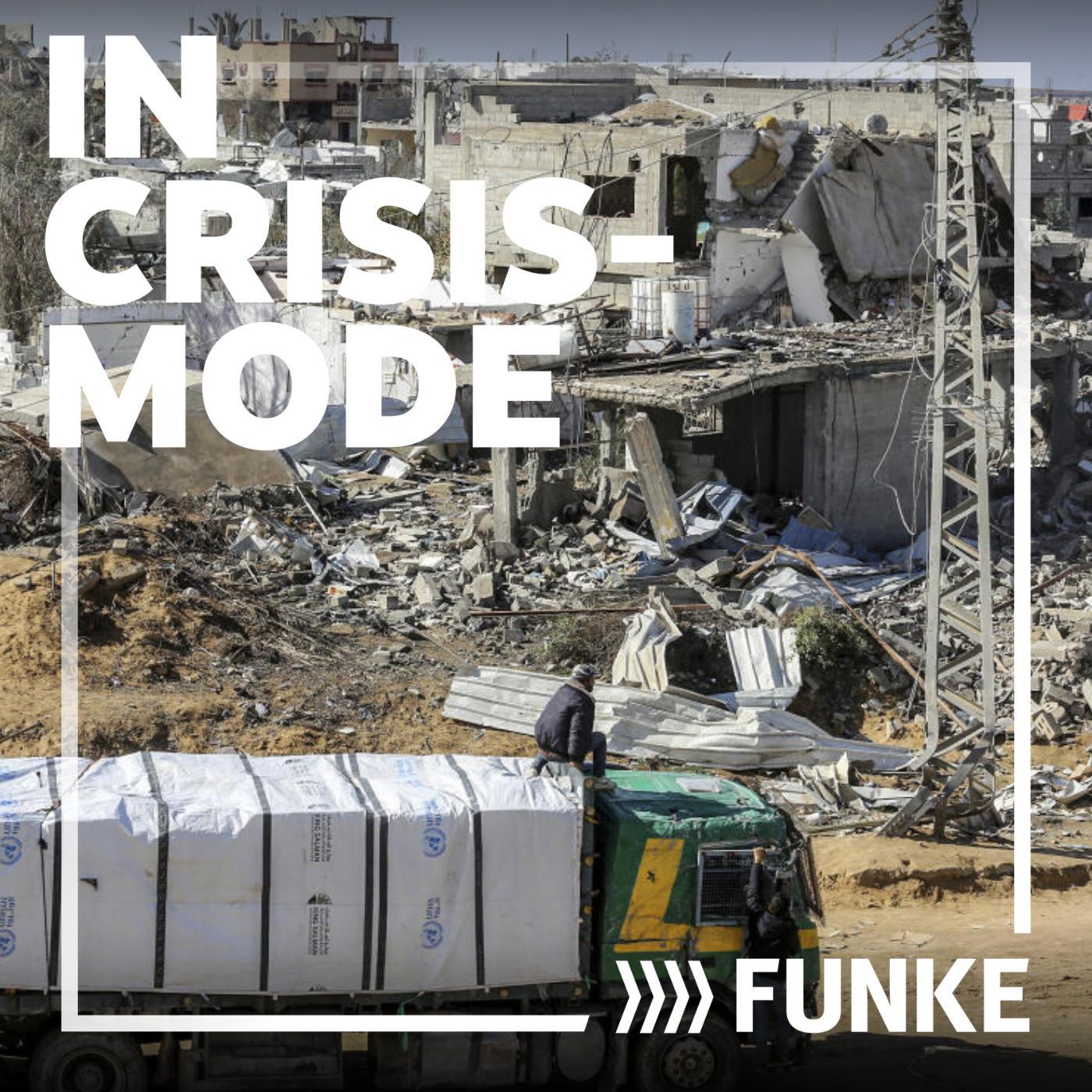
Im Krisenmodus· Folge 123
Gaza During the Ceasefire: Doctors and Experts on the Real Situation
Mittwoch, 26. November 2025 · 13 min
Kapitelklicken springt direkt hin
Shownotes
What is really happening in the Gaza Strip since the ceasefire began? Why are people still dying – despite the pause in fighting and despite humanitarian aid?
In this episode of “In Crisis Mode”, FUNKE war and crisis reporter Jan Jessen speaks with two people who understand just how fragile the situation remains:
• Jan Wynands, a plastic surgeon from Bonn who spent three weeks operating in the Gaza Strip with Doctors Without Borders.
• Jan Busse, Middle East expert at the Bundeswehr University in Munich.
They describe destroyed hospitals, severe shortages of supplies, political pressure – and the fundamental question of whether this ceasefire can truly save lives.
🧭 Episode Overview
1 – One Month of Ceasefire
What has genuinely changed – and what hasn’t?
2 – Diplomacy Under Pressure
The U.S., Israel, Hamas: Why the ceasefire lasts only as long as Washington maintains pressure.
3 – The Question of Disarmament
Why this issue could jeopardize the entire peace plan.
4 – Hospitals at Their Limit
Surgeon Jan Wynands on shortages, winter cold, and the lack of essential medicines.
5 – Trauma, Daily Life, Survival
How people in Gaza experience this brief respite – caught between hope and fear.
6 – What Is Needed Now
Shelter, warmth, water – and above all, a political horizon.
7 – Conclusion
Why this ceasefire can only be a beginning – if it lasts at all.
🤝 How to Support
Welthungerhilfe
Food, water, education – helping communities help themselves.
🔗 Website: welthungerhilfe.de
Doctors Without Borders
Medical support for people in the Gaza Strip – independent and on the ground.
🔗 Website: aerzte-ohne-grenzen.de
📬 Contact & Feedback
Questions, comments, suggestions? Write to us:
✉️ krisenmodus@funkemedien.de
🟢 Subscribe Now
“In Crisis Mode” – available wherever you get your podcasts:
Spotify | Apple Podcasts | Deezer | YouTube
📅 New Episodes
Every two weeks, always on Wednesdays.
In Crisis Mode is a podcast by the FUNKE Media Group.
Transkriptvom Podcast bereitgestellt · Zeitmarken springen hin
The guns have fallen silent, at least mostly. For a month now, a truce has been in place between Israel and Hamas in the Gaza Strip. And yet everything still feels dangerously fragile. Aid convoys are getting through, but only a trickle. People are returning to what's left of their homes. Often nothing more than broken concrete and twisted metal.
Beneath Rafah, fighters remain holed up in the tunnels, refusing to surrender. So the question is, what is actually happening in Gaza during this ceasefire? Und an even harder one, is it truly saving lives? In Crisis Mode, the podcast from Conflict Zones with Jan Jessen. Welcome to In Crisis Mode. My name is Jan Jessen, Head of Politics at NRZ and a War and Crisis Reporter for the Funky Media Group.
In this episode, we want to understand how fragile this ceasefire really is, was happening diplomatically behind the scenes and how the people on the ground are coping as they try to survive among ruins temporary shelters and months of trauma one month of ceasefire it sounds like stability but the reality looks very different what we're witnessing right now is a truce built on almost nothing no political process no reliable oversight no shared vision to understand just how fragile this situation is we're starting with Jan Busse Er ist ein Politiker an der Bundeswehr-Universität in München, und er hat seit Jahren die Mittel-East studiert, und ich habe es genau gesehen, wie das Ceasefire tatsächlich hält.
Ich habe ihn gefragt, ob diese Trucke ist ein Schritt für die Peace, oder einfach eine Taktik für die Pause. Also, ich glaube, es lohnt sich anzufangen, mit einer ganz anderen Dichtung. Donald Trump presented was called a peace plan. But in reality, so far, it's only a ceasefire agreement. And that's a very, very significant difference, because a ceasefire only addresses very short-term factors.
Turning it into a lasting peace is still a long way off. He says both sides are officially sticking to it. Aber wenn wir uns jetzt nur den Waffenstillstand anschauen, dann würde ich sagen, dass die Situation bereits tense ist, weil wir die Verlusten von den Waffenstillstand von beiden Seiten gesehen haben.
Aber gleichzeitig, und ich glaube, das ist die wichtigste Punkt, dass die Waffenstillstand auf beiden Seiten immer noch nicht zu diesem Waffenstillstand verhindert. Und ich glaube, das ist fundamental. At the same time, we can also see that the US administration continues to keep the pressure high and remains very present in the region.
What he is saying, quite plainly, is this. This ceasefire isn't holding because the parties actually want it. It's holding because Washington is forcing it. And even that is only stable to a point, because the interests of Hamas, Israel and the United States are already starting to drift apart again.
Was oft wird überrascht, ohne die Arabischen Mediatorn, dieses Fehlungsfall nicht existieren würde. They're the ones talking to Hamas' representatives, people Israel won't even meet. And they've built their own pressure, both for political and security reasons. He explains how Qatar, Turkey and Egypt were able to push Hamas to compromise.
Yes, so I think the role of Qatar and Turkey was very, very central in reaching this agreement. But we shouldn't overlook Egypt either. Egypt has actually played an important role the whole time and continues to do so for various reasons. Clearly, because the Gaza Strip, the only external border it doesn't share with Israel, borders Egypt at the Sinai, near Rafa.
At the same time, because Egypt is expected to take on a leadership role in the context of this international stabilization force, which is planned to be deployed to Gaza in early 2026. And yet, without a political horizon, he says, all of this could collapse at any moment. The most delicate question in the coming months, will Hamas give up its weapons?
And what happens if they don't? Yes, I think that's really where a key problem lies. Das war klar von Anfang an, und die Frage ist, wie eine Disarmung eigentlich aussieht. Ich glaube, es ist extremst unrealistisch zu sagen, dass Hamas einfach nur die Weapons von einem Tag zum nächsten Tag handelt. Von Hamas' Perspektive, das würde anhanden zu Kapitulation. Und Hamas hat immer gesagt, dass es nur die Weapons handelt zu einer Palästinischen Autorität.
Und das bringt uns zu einem Punkt, weil ich denke, dass das ganze Plan, Ich glaube, dieser Geist-Hahn kann nur ein weiterer Schritt sein, wenn es eine genuine politische Perspektive gibt. Erstens, weil das die einzige Szenario, in dem Hamas vielleicht sogar die Weapons geben könnte. Und zweitens, weil es die einzige Möglichkeit, die Unterstützung von Hamas und anderen radicalen Gruppen zu retten. Der Hamas und andere radikalische Kräfte kann tatsächlich unterstützen.
Er macht es klar, dass ohne den Prospekt ihrer eigenen Staten, Hamas nicht komplett verändern will, und Radikal-Gruppen wird weitergehen. While politicians and diplomats negotiate, medical teams are trying to achieve the impossible. One of them is Jan Weinens, a plastic surgeon at the University Hospital Bonn, who has just returned from Gaza.
He spent weeks operating in overcrowded hospitals, for doctors without borders. I asked him why he went to the Gaza Strip in the first place. Was mich in den Gaza-Strafen gebracht hat, was die Notwendigkeit, was tun zu müssen, was mich in den Gaza-Strip, was die Necessity, die Neid zu tun, was die Neid zu tun.
Und das bringt uns zu einer der Grunde Frage. Ist es genug Hilfe jetzt? Ich glaube, es ist nicht genug Hilfe zu geben, obwohl dieses Cease-Fir in die Lage ist für ein Monat. Menschen sind immer noch die bare Essenz, die Basic-Hygiene-Supplies, die Warmthung, die die wichtigsten an grundlegendem Hygienematerial, an Wärme. A ceasefire, he says, doesn't mean there's enough aid.
On the contrary, the guns are silent, but the suffering remains. Winans describes how quickly the humanitarian system could collapse again. It's misleading to say that's enough, that it's all fine. I've described in some conversations that we were able to provide solid surgical care. But all of that material comes from outside.
Through large organisations, like Doctors Without Borders, which I was working with there, and everything is basically hanging by a thread. Whether it's medical equipment or other supplies, food, etc., if that lifeline is switched off, all of it can quickly run out and care can no longer be provided the way I was able to do it.
Right now, it was the ceasefire that meant fewer patients with severe acute injuries were coming in, so there was enough material available to handle them. Schwerstverletzungen kamen und man somit dann auch ausreichend Material hat. Winans is describing a system that could collapse overnight and everyone knows it, including the people in Gaza.
He also explains what is still medically possible in Gaza. Aber es auch noch eine Frage, was das jetzt für die Kinder anbelangt ist. Zum Beispiel, wenn es an der Verbreitung auf die Kinder zu tun ist, die Schnauble sind schnell ausgewertet worden. BASIC SURGERY. Was das bedeutet? Das heißt, dass eine Exkontrolle einer Fixator für eine Stabilisierung der Koste, der einen Torbünen, oder die Schnaublein anmütiert die Schnauble sind nicht mehr selbrennen.
Das ist möglich. Aber wenn es um die Schnauble zu benutzen ist, Dressing Materials, specialized Bandages, as well as Painkillers and Antibiotics. The supply is quite limited. What he describes shows just how close the aid system is to its limit. One big explosion, one airstrike and it would be overwhelmed instantly.
How are the people experiencing this ceasefire? As relief or as an illusion? Das ist eine Ernüchterung, ein Durchatmen, das jetzt damit, und das habe ich auch so wahrgenommen, Es ist ein sobering Moment, a chance to take a breath, and, as I perceived it, a Moment to at least start again today, rather than tomorrow, to return, at least in part, to where a house once stood, or to the land itself, and to see what might be possible for the future.
On one hand, there's certainly a sense of relief, but it's paired with a clear realism. These are people my age who have already lived through several wars. I'm in my mid-40s, and their children have already experienced three wars by the time they turn 10. So I think there's also a sense of new beginnings. And again, people are taking action today rather than postponing it to tomorrow.
I find that incredibly admirable, Aber es ist auch eine große Herausforderung, besonders jetzt, als die Menschen starten zu confronten, all die damage, physical, psychologisch, die Erinnerung, und die Menschen, die sie verloren haben. Und ich denke, das ist auch ein sehr tangierender Börden für viele meiner Kollegen, die ich in direktem Gespräch mit in der Gespräch mit in der Gespräch.
Und auch vieler Kollegen, denen ich im direkten Gespräch begegnet bin. Was er beschreibt, ist eine Gesellschaft in Suspension, zwischen kleinen Momenten des Reliefs und der Angst, was kommt. Und er sagt auch, Kinder sind da, die drei Kriegen haben, bevor sie sogar zehn Jahre alt sind. Was macht das für eine Gesellschaft, für die Zukunft?
Wynan sagt, es ist nicht nur die Injuries, die bleiben, sondern die Gespräche, und einige bleiben mit ihm, selbst nach ihm zurück. Ich glaube, was mich nachträglich bewegt, und ich würde sagen, dass das wird, und ich würde nicht sagen, dass es mich nur die Welt wir leben, sondern es ist einfach die Realität.
Was mich bewegt, sind diese Gespräche, besonders mit Kollegen, die mir, für instance, wie ihr 8-Jährige Vater hat sofort nach einem Explosion oder Rockett-Attack. Und diese sind Gespräche, Gespräche. Begegnungen, Gespräche, wo man selber ja auch keine Worte hat. These are stories that happen in Gaza every single day. And they show, this ceasefire is not a reset.
It's a moment when people finally grasp what they've lost. At the end, I asked him what, in his view, is most urgently needed right now. His answer is shockingly clear. Die liste ist lang. Gaza braucht Frieden. The list is long. Gaza needs peace, first and foremost. Gaza. The people need a life with dignity.
Right now, even if houses can't be rebuilt overnight, they need at least more tents, more blankets, more warmth, basic hygiene supplies, and more food. Yes, you can see that in the past two or three weeks, things have improved a little. But it's also clear that everything is still far from normal. So in order to enable a dignified future, all of this is needed.
Concretely, with winter coming, people need warmth, food and a roof over their heads. We often talk about Gaza as if it's a state of exception. But for the people living there, it's everyday life. And this ceasefire, fragile as it is, also shows even the minimum must constantly be defended humanitarily, politically, diplomatically.
And I think what you can take away from this episode is something very simple. Nothing in this situation is stable. And that's exactly why looking away is not an option. We cannot solve this conflict. But we can decide whether we allow a place like Gaza to vanish from our awareness. Denn wenn niemand ist, dann nichts passiert.
Nicht nur dieses Fragile Ceasefire. I've often heard from people in war zones. It helps us just to know you're telling what's happening here. And that applies here too. So stay attentive, ask questions, talk about it. It's not a solution, but it keeps the issue alive. And at the moment, that might be the only thing the people there have.
I'm Jan Jessen. Thank you for listening. This was In Crisis Mode, the podcast of the Funkamedia Group. This episode was produced by Alexander Baumeister, who is also a journalist at one of Funker's radio stations. If you appreciate our work, follow us, rate us and feel free to send your questions and topic suggestions to christenmodus at funkamedian.de.
Thank you for listening. Take care of yourselves. See you next episode. Ciao. Musik.
