

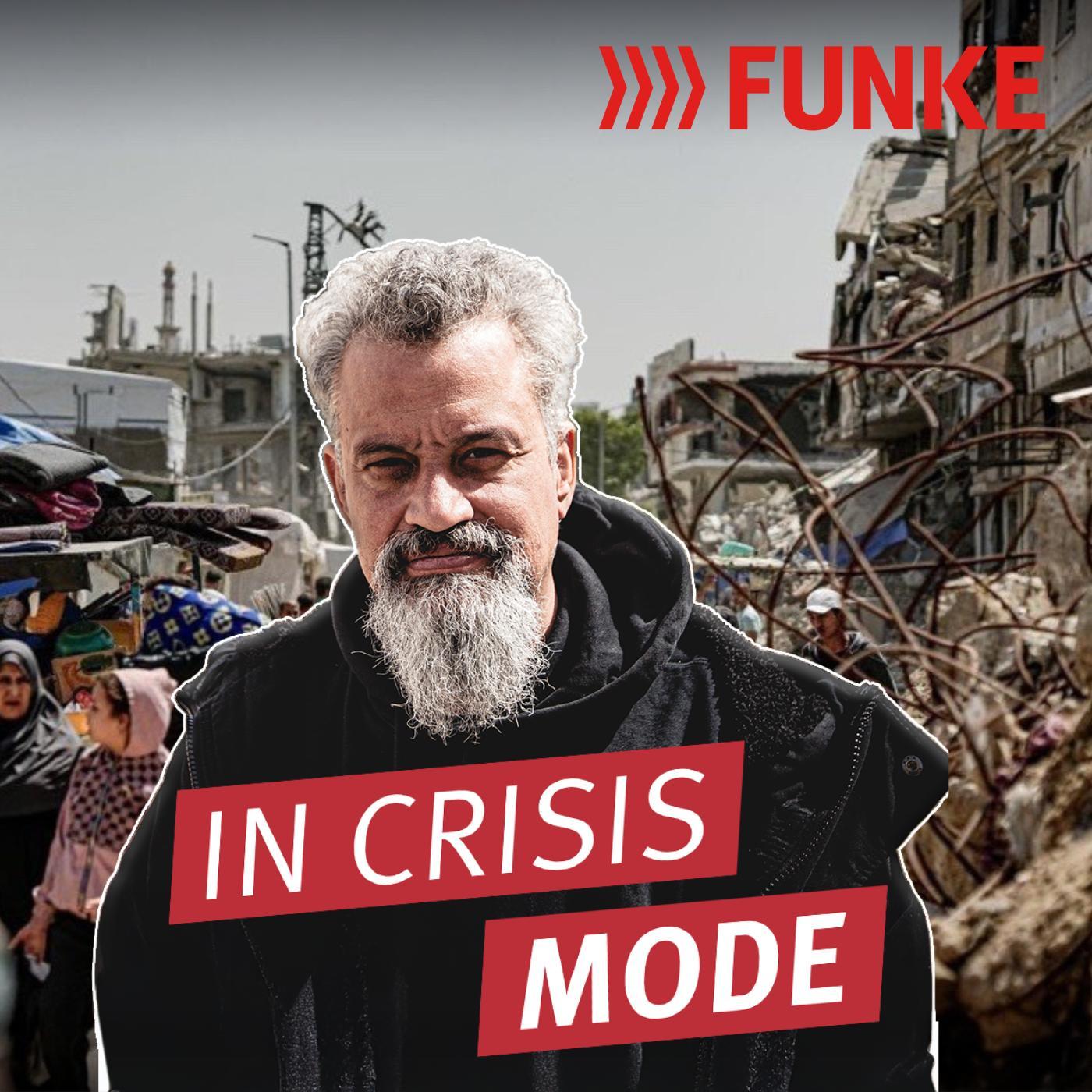
Im Krisenmodus· Folge 86
"No Safe Place" – Voices from Gaza’s War Zone
Mittwoch, 30. April 2025 · 22 min
Kapitelklicken springt direkt hin
Shownotes
Note: This episode uses artificial intelligence to translate and dub the voice of Jan Jessen into English.
In this epsiode of "In Crisis Mode (nrz.de/podcast/im-krisenmodus)", you'll hear voices from the ground, analysis from FUNKE war reporter Jan Jessen (nrz.de/autoren/jan-jessen), perspectives on hope and change. What ended the ceasefire - and is there any hope left amid the destruction?
🎙 In this episode, you’ll hear from:
• Georgia Tacey, who coordinates relief efforts for Save the Children in Gaza – and shares what daily survival looks like on the ground
• Ali, a father from Rafah, living through bombings and loss with his family
• Usama Antar, a political scientist offering clear-eyed analysis from exile
🧭 Chapter overview:
1 | No Safe Place Left
Georgia Tacey from Save the Children reports directly from Gaza. She describes a reality in which evacuation orders are meaningless — because there’s simply no safe place left.
2 | A Childhood in Ruins
Thousands of children have died, and the survivors are severely traumatized. Georgia shares stories of births in tents, babies in cardboard boxes — and efforts to rebuild emotional connection in broken families.
3 | What Ali from Rafah Is Living Through
Ali and his family live in constant fear, displaced again and again without protection. His words show the devastating impact of the war on everyday life — and the deep longing for peace.
4 | Political Firestorms and Power Games
Usama Antar offers analysis: What is Trump planning? How is Israel responding? What role does Hamas play — and what’s behind the protests against them?
5 | Hope Against All Odds
Despite the violence, there are voices calling for peace — in Gaza and in Israel. Ali and others prove: Humanity can’t be extinguished, even in the darkest times.
🎧 Also check out these epsiodes:
• Kobane - The city that won't fall (morgenpost.de/podcast/article408743504/kobane-…)
• Myanmar in Ruins (morgenpost.de/podcast/article408672264/myanmar…)
🆘 Help out!
Save the Children provides emergency medical care, humanitarian aid, and protection programs for children in Gaza. 🔗 Donate or learn more here (EN) (savethechildren.net/what-we-do/emergencies/war…)
📬 Contact
Questions, feedback, topic suggestions?
Email: krisenmodus@funkemedien.de
🟢 Subscribe to
In Crisis Mode for free on
Spotify (open.spotify.com/show/0IQW1w25NYSrz60aAPzwvB?s…), Apple Podcasts (podcasts.apple.com/de/podcast/im-krisenmodus/i…), Deezer (deezer.com/de/show/3737197) or YouTube (youtube.com/@Krisenmodus-Podcast_FUNKE)
Search for In Crisis Mode and hit "Follow"
🗓 New Episodes
Every other Wednesday
Voiceover: Thomas Bertram (radiooberhausen.de/moderator/thomas-bertram-26…)
In Crisis Mode is a podcast by FUNKE media group
Transkriptvom Podcast bereitgestellt · Zeitmarken springen hin
Where to go when there is no safe place left? When every noise becomes a threat? When home is nothing but rubble tomorrow? What happens when family members die? The Gaza Strip, a narrow strip of land by the Mediterranean Sea, is currently a place of horror. Since the 7th of October 2023, after the brutal attack by Hamas, the situation in Israel has dramatically escalated.
And you may have noticed there was a ceasefire between January and March. Brief hope for the people in Gaza. Israeli attacks have resumed since mid-March. What remains is a humanitarian catastrophe. Children are dying. Families lose everything. People simply don't know what to do anymore. Georgia Tacey from the aid organisation Save the Children speaks of more than 50,000 dead, 15,000 of whom are children.
Today I've had two different evacuation notices on my phone for families to immediately, within five minutes, pack up their belongings and leave and go to a safer zone, even though there is no safe place in Gaza anymore. Im Krisenmodus, der Podcast aus Krisen und Kriegsgebieten aller Welt. Mit Journalist Jan Jessen.
Welcome to In Crisis Mode. I am Jan Jessen, Journalist and Crisis Reporter for the Funkimedia Group. My texts appear, among others, in the Berliner Morgenpost or the Hamburger Abendblatt. And of course, also on our portals. You have just heard Georgia Tacey. She works for the International Children's Aid Organisation, Save the Children. For months, she has been supporting people in the centre of the Gaza Strip.
Georgia reports explosions, drones, fear of a childhood in war. And I think it's just this constant state of anxiety that you see in children because they don't know when the next explosion, when the next family member will be lost. They don't know when their mum leaves to go to the market. Will their mum come back? They have seen so much death and they have seen so much destruction that obviously this trauma will stay with these children their entire lives.
Georgia also describes how degrading life has become. Mothers are giving birth to their children in tents, completely without medical care. Childbirth is not considered as a critical procedure to be admitted into these hospitals. So women are giving birth in their tents and often dying needlessly of complications.
Und dann müssen sie ein Baby in die Welt bringen, in diesen Tents zu bringen. Wir haben gesehen, dass Mothers ihre Newboards in die Karte auf dem Karte auf dem Karte auf dem Boden bringen, um sie zu verhindern, dass sie in den Insekten über sie kommen. Wenn Sie die Bilder von Gaza currently sehen, dann Sie nur sehen, rubbel, rubbel, rubbel.
Das applies zu den Städten wie Kanunis, Rafa, Deir al-Bala. Basically, alle die Städte in der Gaza Strip. And of course, medical care is also in ruins, clinics are destroyed. Medications are missing, hygiene products are scarce. At the same time, there are daily new evacuation orders, even for facilities that should actually be protected.
When you drive through Rafah in armoured vehicles, it looks like a movie set. It looks so unbelievable, the scale of destruction. It looks like CGI or something that is not real. Of course, what Georgia is describing there is terrible. However, the truth also includes one must never forget. So I mentioned initially that back then, this whole catastrophe in Gaza started with the attack of Hamas, this Islamist terrorist organization, on Israel on October 7th, 2023.
We have already reported on this multiple times in this podcast, and we will also include the episodes in the show notes for you. And Hamas is simply waging a war, specifically an asymmetric war, a war where their fighters attack in civilian clothes from civilian infrastructure and attack the Israeli forces.
Basically, it means, yes, you do not really know when shots are fired from a hospital, when shots are fired from a school, when headquarters, military command centers are in such facilities. If they are integrated, then these facilities also become military targets. And that is also somehow the calculation of Hamas. They want these civilian facilities to be attacked.
Israel responds to attacks from such facilities with very great severity. Das ist auch ein Teil der Wahrheit, so vielleicht mit exzessive severität. Und natürlich gibt es auch immer war crimes in der Krieg. Also, die Israelien forces haben natürlich auch gemacht, in einem Ort oder anderen. Es gibt jetzt viele, viele Punkte für das.
Aber, als ich gesagt habe, man muss nicht vergessen, was das Konflikt war. Unfortunately, das ist oft overlooked in den Reporten. Und Hamas weitergeht, dass es jetzt noch weitergeht. There are still rocket attacks from the Gaza Strip on Israeli cities. And yes, a very big issue is the fate of the Israeli hostages.
More than 50 are still in the Gaza Strip. And Hamas is just refusing to release these people. This could or would at least pressure the Israeli government to agree to a ceasefire again. However, that's not happening at the moment. And in this respect, the whole situation is currently completely deadlocked. Und natürlich, besonders terrible und catastrophisch für die civilians.
Despite alles, viele Menschen wollen bleiben. Sie sehen Gaza als ihre home. Also, Georgia's colleagues aufs site sind, Sie sprechen über das. Gaza ist ihre birthright. Das ist ihre home. Sie wollen bleiben. Sie wollen ihre Leben hier. Sie wollen ihre Kinder hier. Sie wollen ihre Leben hier. So, als Sie sind, ich weiß, die meisten unserer staff, es ist eine headline, Sie wollen sie ignorieren. Der Headline, die Georgia gerade erwähnt hat, ist dieser quasi-seemige Plan von Donald Trump, der Präsident amerikanischen Präsidenten.
Trump ist die komplette Repopulation der Gaza Strip. 2 Millionen Menschen werden aus Gaza gebracht werden, zu anderen Ländern. Die Leute diskutieren oder diskutieren dies. Mit Ländern wie Jordan, Egypt, Somalia, Somaliland und anderen. Und Trumps' Idee ist, dass, als die Leute rauskommen sind, wir die Gaza Strip wiederholen. Und dann wird es eine Art Riviera des Middle East.
Ist ein Plan, das völlig total ist, aber ist unterstützt von der Israelien Regierung. Benjamin Netanyahu, der Right-Wing Prime Minister von Israel und die Regierung, dieses Kabinett, denken das Plan ist gut, denken es gut und glauben, dass es all die Probleme kann. Das ist, natürlich, ein Plan, das all internationales Verfahren contradicts.
Wie gesagt, es ist eigentlich total insane. Du kannst nur 2 Millionen Menschen aus ihrer Hohenland nehmen, remove them. In this case, it would indeed be an ethnic cleansing. And yes, in that respect, it is a plan that also faces severe international criticism and certainly would not contribute to calming the situation.
Physical closeness, emotional connection, that is also a topic. Many mothers haven't hugged their children for years, says Georgia, from being overwhelmed. Because one of the things that we're seeing is that there is not enough physical interaction between mothers and their children because that is a sign of and a consequence of trauma for both mum and the child, that there is just no more emotional energy left to be hugging and nurturing your children all the time when you have so many responsibilities on you.
So part of our program is to reintroduce mothers and children to more touching and nurturing behaviours and to see just how emotional it is for both mothers und für Kinder zu sagen, das ist die erste Mal ich habe mein Kind in vier Jahren weil ich nicht mehr able zu cope mit den demanden von fünf oder sechs Kindern, von mir auf meine Schulter, ich habe nichts mehr für jemanden.
Das sind natürlich bitter words. People we are regularly in Kontakt mit in Gaza experience this. So, people who live in Gaza und witness this catastrophe daily seit 7 October 2023. One of these people is Ali. Ali is not a real name, because we need to protect the man a little bit, as he is also a critic of Hamas, and someone, as I said, with whom I have been in contact for months.
He sends me pictures every day, assessments, how it looks right now. That also always varies. Sometimes, of course, he has hope that there will be a peace settlement again, that there will at least be a ceasefire. Then he feels better again, and then there are these emotional lows. Yes, and currently he is in our, I believe, very poor mental state, Ali, whom we have already introduced in this podcast.
As mentioned, we will include the episodes in the show notes. Ali has a family of seven in total, so five children, his wife, himself, and his mother, who is still with them on their journey. And he actually lives in Rafa, in the south of the Gaza Strip, but he has been repeatedly displaced from there due to the constantly recurring evacuation orders issued by the Israeli army. Always be careful.
You have such and such amount of time to leave your homes and go to so-called evacuation zones that we will not attack. And those who do not leave risk dying in bombing attacks. So Ali keeps moving. Currently he is in Khan Yunis, north of Rafa, with his family and they are in a ruin where they have taken shelter.
And yes, as mentioned, he is now somehow anything aber in einem guten Mood. Nachdem alle dachten, der Krieg sei mit dem Waffenstillstandabkommen im Januar beendet, aber leider, es schien weiter alles eine Pause für die Kämpfer zu sein und ihre Kanonen wieder aufzuladen, nachdem sie die Krieg ist. Everyone thought the war had ended with a ceasefire in January.
But in reality, it was just a break for fighters to reload. After they destroyed all basic life infrastructure in Gaza, Schools, hospitals, power stations, water wells, sewage systems, everything was flattened. They turned Gaza into a desert of rubble. What hurts most is seeing my children, who haven't gone to school in two years, terrified by bombings, and I can't calm them. For them, everything is gone.
Education, joy, play, only the death toll keeps rising. I watch them and worry, will they be next? We have paid twice over for a crime we didn't commit. We suffered under Hamas' dictatorship too. We have never been enemies or hated Jews. I believe we are brothers in humanity and advocates of peace. The massacre on October 7 saddened me as much as every massacre in Gaza.
My heart breaks for the mothers, wives and children still missing and held hostage for over 550 days by Hamas. This walk cannot be described in words. Ob sie das nächste Opfer sind? Leider, wir haben bezahlt den doppelten Preis für eine Sünde, die wir nicht gemacht haben. Wir haben zuvor unter der Ungerechtigkeit der Herrschaft und der Diktatur der Hamas gelitten.
Und wir wären nie Feinde oder haben die Juden gehasst. Ich glaube, wir sind Bruder in der Menschenheit und Verpflichtung von Frieden und Liebe. Das Gemützel vom 7. Oktober hat mich so traurig gemacht, wie jedes Gemützel im Gassastreifen. Es bricht mir, das Herz und meine Gedanken sind täglich sünderisch bei der Mutter, der Frau oder dem Kind, deren Vermisste seit mehr als 550 Tagen immer noch und der Hamas im Gassastreifen entführt wird.
Es ist unfair, diesen Krieg mit Worten zu beschreiben. Das ist, was mich immer immer in den Gesprächen mit Ali hat. Er ist immer jemand, der sich für balance antwortet, der immer für peace antwortet, der sagt, was Hamas getan hat, auf 7 Oktober 2023 und was die Organisation mit Hamas getan hat, die Killingen von 1,200 Israeli-Leute, die Rape von jungen Frauen und Frauen, die Abduction von 250 Menschen in die Gaza Strip.
So on the one hand, that was the reason for what is currently happening in Gaza. But on the other hand, he says, this is also not at all compatible with Islam, for example, which Hamas and others refer to. And yes, Ali kept telling me that he hopes there will eventually be a peaceful resolution again.
But there seems to be relatively little sign of that. Usama Anta also provides his view. He is a political scientist, originally from Gaza and previously worked for a German foundation. And Usama Anta was able to leave the Gaza Strip when it started on October 7th, 2023 and currently lives in Egypt. And I am also in contact with him from time to time to get an understanding of what is happening in Gaza.
Vielen Dank. Es gibt keine minimalen Lebensgrundlagen. Die Menschen in Gaza sind am Rande des Wahnsinns. People in Gaza are on the brink of madness. They don't know what to do. Between the daily killings, lack of food for small children and the madness of American and Israeli politics, many just wish for death.
We can't tell if Trump's threat of expelling Gaza's population is political pressure or an actual strategy. It's likely over a third of Gaza would agree to leave, Aber nur zu einem guten Land, nicht zu Egypt, Jordan, Syrien, Libanon oder Somalia. Sie würden zu Europa oder den Gulf-Staten gehen, wo eine bessere Leben ist.
Viele Menschen wollen Hamas nicht mehr. Sie wollen nicht in Macht oder Politik. Menschen sind nicht zufrieden der resistance. Sie wollen friedliche Lösungen. Hamas ist hier sehr hattet. Ich glaube, dass es keine Zukunft für Hamas oder der Islamic Dschihad ist. Aber die größte Hattung ist bei Israel und den USA und Europa für ihre Rolle in Killinge.
Oder eventuell in den Gulfstaaten, wo eine gute Arbeit und ein gutes Leben möglich ist. Die überwiegende Mehrheit der Bevölkerung möchte in Zukunft nicht mehr von Hamas sehen. Sie wollen Hamas wieder in der Regierung noch in der Politik sehen. Die Menschen sind müde vom Widerstand und wollen nur noch friedliche Lösungen.
Hamas in Gaza ist sehr stark verhasst. Und ich glaube nicht, dass irgendeine Zukunft für Hamas oder den Islam-Jihad geben wird. Aber das größte Hassgefühl richtet sich gegen Israel, die Totung der Missionarie, und auch gegen die USA und Europa, die zur Totung von Zivilisten beitragen. Was Antara gerade gesagt hat, über Hamas, ist sehr wichtig.
Ich weiß nicht, ob ihr das vermerkt habt, aber es gab, für die erste Mal in Jahren, Demonstrations in the Gaza Strip by citizens there against Hamas in recent weeks. So there was a specific call for Hamas to finally stop, for Hamas to dissolve. The people just don't want it anymore. So there is of course a certain level of support for Hamas in the Gaza Strip.
People talk about it so that somehow 30-40% of the people in Gaza support Hamas, but a large part does not. Und diese Demonstrationen waren ein breit Grund für Hoffnung. Und Ali apparently partecipierte in einer dieser Demonstrationen und mir auch ein paar Bilder. Und ja, es scheint, als ob die Dominanz der Hamas in der Gaza Strip wäre, könnte man riskieren.
Das wäre natürlich wunderbar, weil es genau die Extremisten, die wollen diese Konflikten weitergehen, die es, die Resistenz gegen Israel, ja, und gegen die Israeli-Occupation, for it to continue no matter the cost and who also celebrate every dead civilian as a martyr. Weil sie wissen, dass die Kinder die Bildung der Bildung brauchen, um die Angst zu bringen, gegen Israel zu bringen.
Und wie ich sagte, es so kurz war, als ob die Supremacy von Hamas in Gefahr war. Dann Hamas hat sich brutal gegen die Menschen, die da demonstriert. Die Menschen waren in den Legen, die demonstriert waren. Die Hospen, die noch arbeiten, waren noch nicht von diesen Menschen verabschieden. On the other side, leading figures of this, indeed, uprising were executed, severely tortured by Hamas before their death.
And the bodies were then placed in front of the family's houses with the note that this happens to everyone. The collaborators are. That is what Hamas said. So people who supposedly represent Israeli interests in the Gaza Strip, which of course is nonsense, because these people primarily want peace. And naturally, these people who are demonstrating against Hamas also criticize the Israeli warfare. What remains?
Well, we can only hope that this uprising against Hamas doesn't completely is over, but that the people there come together again and that Hamas, so to speak, is forced from within the Gaza Strip to engage in a negotiated solution with Israel. This primarily means releasing the hostages. And on the other side, there are also thousands of people in Israel who protested against their own government after the end of the ceasefire in mid-March.
Against this very right-wing cabinet of Benjamin Netanyahu who say. We want our hostages, our relatives, our loved ones to be brought out of the Gaza Strip first. And secondly, the bloodbath must finally end. And there are now also numerous female and male soldiers, female and male reservists, who say we no longer want to fight.
There are open letters from former Air Force and Navy officers who say an end must finally be found to this war because what we are doing there leads to nothing and also damages our reputation worldwide. Nevertheless, it is of course difficult to keep hope when you hear these voices, when you also see the images from the Gaza Strip.
And yes, the situation, as I said, is escalating. The humanitarian situation is becoming more difficult also because currently no aid deliveries are getting into Gaza. And yes, it is currently a very, very difficult situation. I also do not know how and if it can come to a good end. Negotiations are still ongoing in Egypt.
There are repeated signals that Hamas might agree to a prisoner exchange or a hostage exchange. But how seriously this can be taken is the big question. What I think is very important in this conflict is not to simply and unwaveringly take one side, so to speak. That happens, I notice, for example, when I write about it on Facebook or in our media. there is an increasing lack of empathy on both sides.
So, those who are absolutely pro-Palestine, and in this case also pro-Hamas, and those who stand on Israel's side and somehow have no understanding, no empathy for the victims on the other side. I personally find that very, very difficult, because there are indeed so many people who are now directly affected, both in Israel and in the Gaza Strip, who want to be significantly more balanced than many people who always take to the streets in Germany or elsewhere or comment.
And I find that difficult. So I just believe it's important to continue getting informed, to talk about it, and of course to support humanitarian organizations active in the Gaza Strip that help the people there without being politically active. That is, I believe, the only thing we can do from here.
And an act of solidarity towards people like Ali and all the others who are currently in this catastrophic situation. However, it is also important that we give people hope. Ali keeps saying that just this daily talking with me or with other people in Germany helps him somehow maintain morale and not completely fall into depression.
Maybe that is a way to help the people there. And I believe the most important thing is not to look away. I just noticed that the interest in Gaza and what is happening in the Middle East is somehow continuously declining. That must not happen. We need to keep looking there. We will also continue to report on it and keep you informed.
That's it for today's episode of The Crisis Mode. This is a production of the Funkimedia Group. This episode was produced by Alexander Baumeister. He is a radio editor at a station of the Funkimedia Group. If this podcast touches you, share it, subscribe to us on Spotify, Apple Podcasts or on YouTube and write to us.
You can find the email address in the show notes. You can also write to me privately on Facebook, just under Jan. Jessen, you can find me. Thank you for listening and I hope that we soon have some positive news from the Gaza Strip. Take care. See you then. Bye bye. Music.
